What was believed to be the discovery of hidden ancient wealth in a Rajasthan village has been exposed as an elaborate scam, leading to the arrest of two local con artists. The incident, which unfolded in Seedra village of Tonk district, saw villagers and administration officials in a frenzied excavation after rumours of a treasure-filled pot spread like wildfire.
The Midnight Dig and the 'Golden' Discovery
The chain of events began on Saturday when cattle herders in Seedra village, located about two hours south of Jaipur, noticed rose petals, incense sticks, and other prayer items scattered on a patch of grazing land. As news of this mysterious sighting spread, a large crowd of villagers gathered at the spot.
The local administration was alerted and officials, including from the Niwai tehsil, reached the location. Initially, there were suspicions that a body or a foetus might be buried there. District administration officials brought in JCB excavators and began digging on Saturday evening.

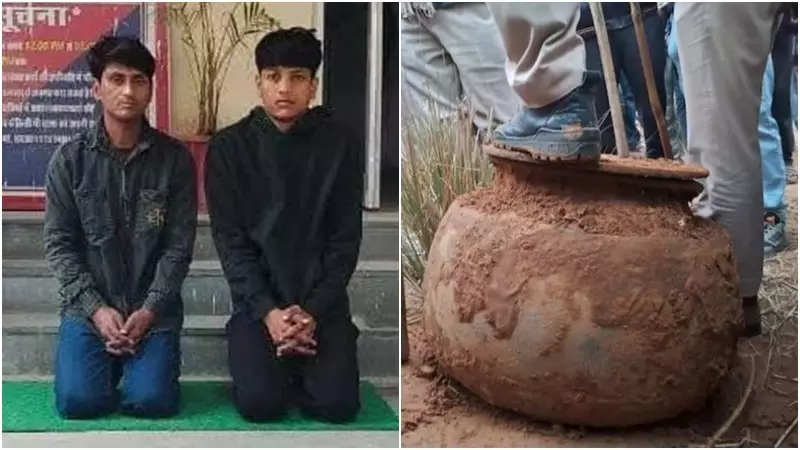
After digging several feet down, the excavation revealed an old, heavy pot, approximately 2 feet in height. According to eyewitness accounts from villagers, the pot contained pieces of a material that looked like gold. "There were yellowish bricks, the size of a soap bar," recounted Bhuri Devi, a local resident.
Chaos ensued as the pot was lifted using the JCB. Villagers jumped towards it, trying to grab the "yellowish" bricks inside, while shouting "dhan hai, dhan hai" (there's wealth). Police had to use lathis to control the crowd, and one policeman reportedly placed his foot on the pot to prevent people from stealing its contents.
Niwai tehsildar Naresh Gurjar then officially seized the pot. It was transported and stored under double lock and seal at the local Treasury office to prevent tampering. This official action only served to fuel the rumours further, prompting some locals to secretly dig near the site late at night, hoping to find more treasure.
The Unravelling of the Hoax
On Monday, the truth began to emerge. A team from the Archaeological Survey of India (ASI) based in Ajmer examined the excavation site. Subsequently, a joint team comprising ASI representatives and local administration officials opened the sealed pot at the Treasury office.
To everyone's disappointment, the pot that had caused so much excitement contained nothing but dust.
Simultaneously, an investigation by the Tonk police uncovered the real story. The police identified the scam as the work of a local gang of "tatlubaaz" (con artists). Deputy Superintendent of Police (Niwai) Ravi Prakash Sharma explained that this gang operates by promising people information about hidden wealth in exchange for money.
"Based on our input, we arrested two persons and retrieved metal bricks from them; the bricks look like they’re gold, but they are actually brass," said Sharma.
The Conmen and Their Modus Operandi
The police arrested Mukesh Meena (32) and Abhishek Meena (24), both residents of Seedra village. Mukesh Meena reportedly runs a Facebook page under the name 'Tatkal Aghori Maharaj'.
Sharing their method, the police said the accused would bury items like the pot deep in the ground. They would then approach potential victims, telling them about "dhan siddhi" (attainment of wealth) or hidden treasure, and demand a sum of money for the revelation. They would take the victims to the spot, perform a puja, and then orchestrate the "discovery" of the hidden "gold." The two have been booked for cheating.
This is not the first time such rumours have captivated rural India. In a famous 2013 case, a sadhu's dream about buried gold in Unnao, Uttar Pradesh, led to a large-scale excavation by the ASI after even government ministers got involved. That dig, too, concluded with no treasure found.