Rebels and Public Discontent Disrupt Nagpur Civic Elections
Rebels, last-minute party switchers, and deep-rooted public resentment emerged as the most disruptive forces in the recent Nagpur Municipal Corporation elections. The BJP secured a commanding lead across the city overall, but it faced surprising reversals in specific pockets where it traditionally enjoyed unquestioned dominance.
Traditional Saffron Turfs Turn into Battlegrounds
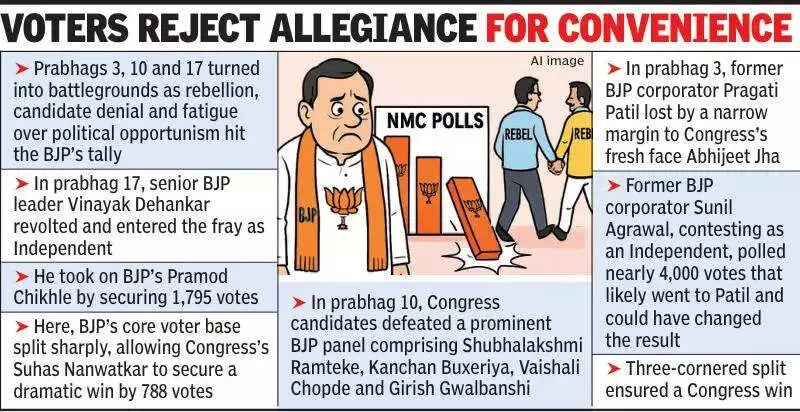
Prabhags 3, 10, and 17, long regarded as safer saffron turfs, turned into unlikely battlegrounds. Rebellion, candidate denial, and voter fatigue over political opportunism hit the BJP's tally hard in these areas. Party insiders openly acknowledge that at least six seats slipped solely because of rebels.
The most high-voltage rebellion played out in Prabhag 17. Senior BJP leader Vinayak Dehankar, husband of former mayor Archana Dehankar, revolted against his own party. He entered the contest as an Independent candidate, taking on the BJP's official candidate and former corporator Pramod Chikhle. Dehankar secured 1,795 votes, splitting the BJP's core voter base sharply. This split allowed Congress candidate Suhas Nanwatkar to secure a dramatic win by 788 votes. Notably, the BJP dominated this ward in 2017, winning three of the four seats.

Civic Grievances Fuel Voter Backlash
Prabhag 10 delivered another significant setback for the BJP. Congress candidates defeated a prominent BJP panel that included Shubhalakshmi Ramteke, Kanchan Buxeriya, Vaishali Chopde, and Girish Gwalbanshi. Here, civic grievances played a key role in the outcome. Voters expressed frustration over rising traffic chaos around commercial hubs, patchy healthcare access, and poor service delivery. They openly linked these issues to the area's sitting representatives. The BJP's organisational machinery, which internally predicted comfortable wins in Prabhags 10, 17, and 3, was left scrambling to explain the losses.
Voter Impatience with Party-Switching
In Prabhag 3, a razor-thin contest reflected growing voter impatience with frequent party-switching and intra-party rivalries. Former BJP corporator Pragati Patil lost by a narrow margin to Congress's fresh face Abhijeet Jha. Former BJP corporator Sunil Agrawal, contesting as an Independent, polled nearly 4,000 votes. These votes likely went to Patil and could have changed the result. The three-cornered split ensured a Congress win in a ward the BJP considered relatively stable.
Broader Message Against Political Opportunism
Beyond these prabhags, the electorate delivered a broader message against political opportunism. Veteran corporators like five-time member Manoj Sangole lost after switching sides. Sangole won the last election on a Congress ticket before moving to the NCP. Four-term corporator Sandip Sahare, denied a Congress ticket and later joining the Vanchit Bahujan Aghadi, met a similar fate. Their defeats underlined a clear pattern across the city. Voters punished rebels, turncoats, and those seen as shifting allegiances for convenience.
In Prabhag 11, BJP's former deputy mayor Sandeep Jadhav lost to Congress's first-timer Manjusha Chacharkar. Chacharkar's husband is now wanted in a case of attempt to murder after his life-threatening bid on the BJP's sitting corporator Bhushan Shingne. Shingne also lost to Congress's new face Shailesh Pandey.