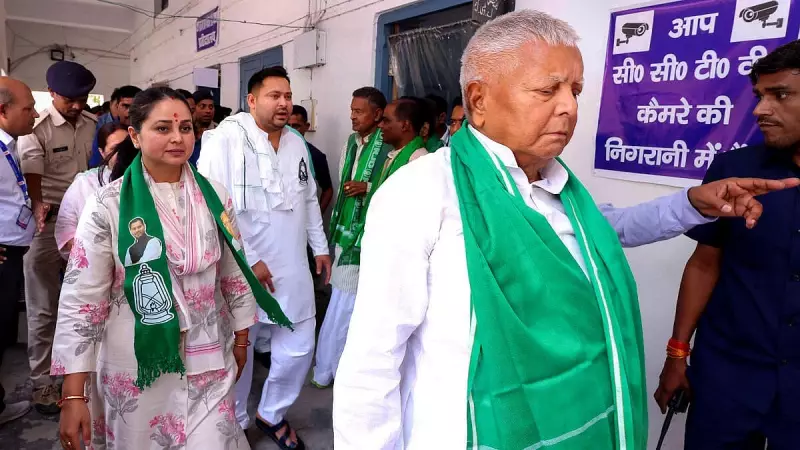
In a statement that has sent ripples through Bihar's political landscape, Rohini Acharya, daughter of Rashtriya Janata Dal (RJD) patriarch Lalu Prasad Yadav, made a sharp and defiant remark concerning her family's political legacy. She asserted that there is no need for outsiders to destroy the legacy built by her father, suggesting that members within the family are sufficient for the task.
A Stark Declaration on Family Dynamics
The comment, made on a public platform, is seen as a pointed reference to the ongoing internal discussions and perceived tensions within the Yadav family and the RJD. Rohini Acharya's words highlight a sentiment that any challenge to the Lalu Prasad Yadav legacy is more likely to originate from within the family fold rather than from external political rivals.
This statement brings into sharp focus the complex dynamics within one of Bihar's most prominent political families. Lalu Prasad Yadav, a former Chief Minister and Union Railway Minister, remains a towering figure, but the question of succession and management of his political heritage has been a subject of much speculation.
The Context of Leadership and Succession
The RJD is currently led by Lalu Prasad Yadav's younger son, Tejashwi Yadav, who also serves as the Leader of the Opposition in the Bihar Legislative Assembly. Tejashwi has been the party's face in recent elections and is widely seen as the political heir. However, Lalu Prasad's eldest daughter, Misa Bharti, is a Rajya Sabha MP, and other children, including Rohini Acharya, are also active in the public sphere.
Rohini Acharya, who lives in Singapore, is known for her active and often outspoken social media presence in defense of her father and the family. Her latest remark, however, ventures into more critical territory, indirectly acknowledging the existence of internal fissures. It underscores the notion that the preservation or dilution of the Yadav political legacy is primarily a family affair.
Political Repercussions and Interpretations
Political analysts are interpreting Rohini's statement as a reflection of the underlying tensions that can exist in large political families where multiple stakeholders have aspirations and viewpoints. By stating that "my family members are enough" to handle the legacy, she has openly framed the discourse around internal responsibility, for both its upkeep and its potential decline.
The remark is unlikely to be taken lightly within RJD circles. While it does not name any specific individual, it adds a new layer of public intrigue to the party's internal functioning. It comes at a time when the RJD is striving to present a united front against the ruling National Democratic Alliance (NDA) in Bihar.
For the party's supporters and opponents alike, this candid admission from a family insider serves as a rare glimpse into the challenges of managing a dynasty built over decades. The focus now shifts to how the key figures within the RJD, particularly Tejashwi Yadav and Misa Bharti, navigate this publicly aired sentiment and whether it leads to any visible changes in the party's internal cohesion or public narrative.