

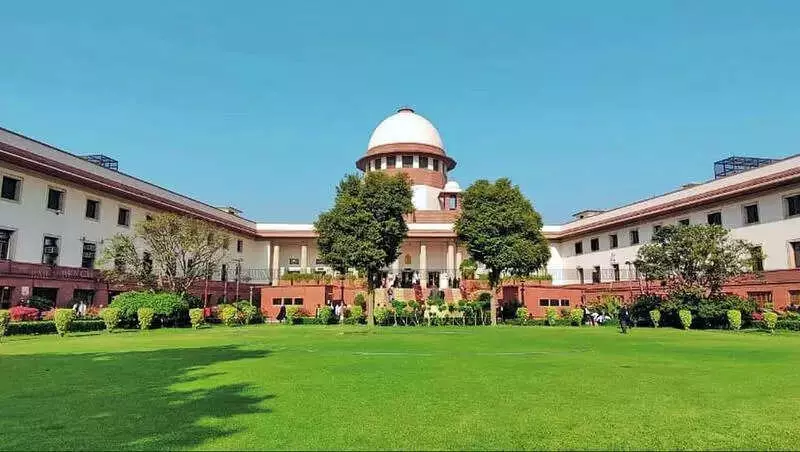
A heated legal battle erupted in the Supreme Court on Monday as the states of Telangana and Andhra Pradesh locked horns over the contentious Polavaram-Nallamala Sagar Project (PNSP). The dispute centers on allegations of water misappropriation and has escalated into a significant inter-state conflict.
Core of the Controversy: Water Rights and Allegations
Representing the Revanth Reddy-led government, senior advocate A M Singhvi vehemently opposed Andhra Pradesh's move to proceed with tendering for a detailed project report (DPR) for the PNSP. Telangana's core accusation is that the N Chandrababu Naidu-led Andhra government is attempting to misappropriate around 200 tmc (thousand million cubic feet) of water from the Godavari River, which is rightfully Telangana's share.
Singhvi informed a bench headed by Chief Justice of India Surya Kant and Justice Joymalya Bagchi that the Andhra government was pushing ahead with the project despite a high-powered committee led by the Central Water Commission chairman advising against it. He argued that the project would severely impact Telangana, which is in the process of building barrages to utilize its allocated share of 968 tmc of Godavari water. "It is a huge emotive issue in Telangana," Singhvi stated, emphasizing the perceived threat to the state's water security.

Andhra's Defense and the Supreme Court's Scrutiny
Andhra Pradesh, represented by senior advocates Mukul Rohatgi, Jaideep Gupta, and Balbir Singh, presented a starkly different narrative. They contended that the PNSP had Telangana's consent at the time of the state's bifurcation in 2014. Rohatgi clarified that the tender was merely for preparing a DPR for an irrigation project designed to utilize only excess flood water flowing through Andhra, the lower riparian state.
The bench, however, raised a fundamental jurisdictional question. It questioned whether a writ petition by a state was the appropriate course when the dispute essentially involved the implementation of Godavari water allocation among multiple states, including Karnataka and Maharashtra. The court suggested that Telangana consider filing a suit under Article 131 of the Constitution, making all three states parties to the case.
Way Forward and Next Steps
The Supreme Court provided Telangana with a week to decide its legal strategy. The state must choose between pursuing a full-fledged constitutional suit or accepting the court's alternative proposal to direct the high-powered committee to expedite its decision on the project's viability.
Highlighting the interconnected nature of river water disputes, the CJI-led bench remarked that in inter-state water sharing, no state can claim that other riparian states should not be concerned with projects undertaken within its borders. The court has scheduled the next hearing for January 12, setting the stage for a crucial decision that will shape the future of water politics in the region.






