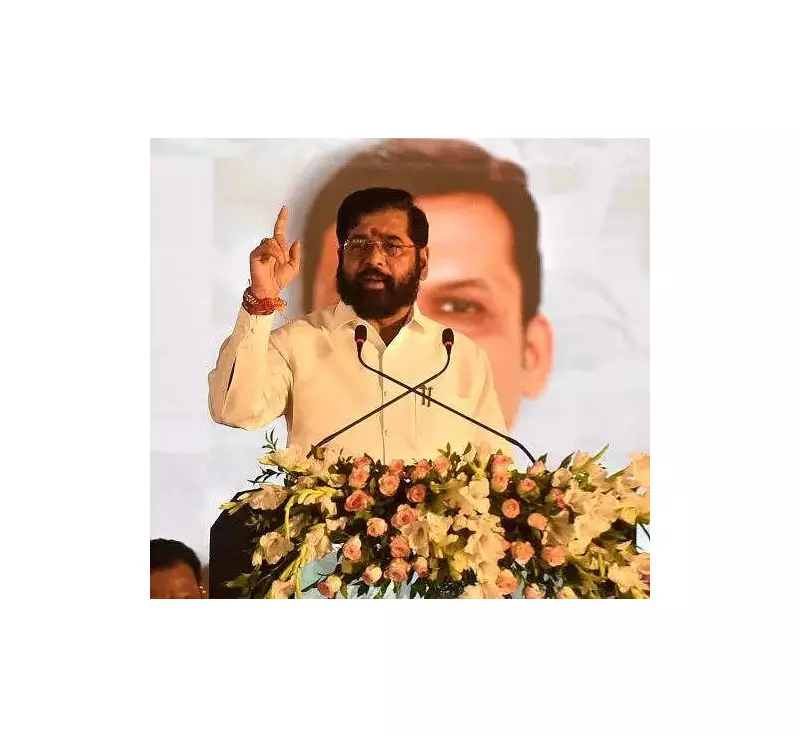
In a major push ahead of the crucial Brihanmumbai Municipal Corporation (BMC) elections, the Shiv Sena led by Deputy Chief Minister Eknath Shinde has unveiled a comprehensive urban redevelopment and economic empowerment manifesto. The party's core promise revolves around a massive cluster redevelopment policy aimed at transforming 17 large slum pockets in Mumbai, areas it identifies as predominantly Maharashtrian settlements.
Housing and Infrastructure: The Core Poll Plank
Arguing that the civic body must be aligned with the state government for effective governance, the Shinde-led Sena has made housing revamp its central electoral agenda. The party plans to implement the city's 2034 Development Plan through a cluster-based approach, citing the Ramabai Nagar project as a successful template. Former MP Rahul Shewale stated that controlling the state's urban development department would expedite these projects.
Shewale explained that each of the 17 identified clusters, spanning approximately 15 hectares each, will be redeveloped on the lines of Ramabai Nagar. In that project, about 4,000 residents were provided transit accommodation and rental support. The new vision is to replace isolated vertical slum buildings with integrated township-like neighborhoods. These will include proper housing, parking facilities, open spaces, healthcare centers, schools, and commercial zones.

In a move rich with symbolic significance, the party has also planned seven additional clusters in the Prabhadevi and Dadar areas, including the Khandke building precinct. Shewale emphasized that this area is where Hindu Hridaysamrat Balasaheb Thackeray groomed the Shiv Sena in its early days.
Economic Empowerment and Mega Projects
Beyond housing, the manifesto strongly focuses on the economic upliftment of the Marathi community. As a tribute to Balasaheb Thackeray on his birth centenary on January 23, the party plans to launch initiatives to partner with emerging Marathi entrepreneurs. Shewale highlighted that many lack seed capital despite having ideas and skills. The proposed solutions include government-backed seed funds, credit guarantee schemes, and innovative partnership models.
"Economic empowerment of Marathis is central to preserving Mumbai's character," Shewale asserted, pointing out that skyrocketing real estate prices over the past decade have displaced the city's original residents. The party is also considering special provisions for pagdi tenants, a long-standing and contentious housing issue in Mumbai.
Shewale stressed that Mumbai's scale requires robust state-level leadership, as the BMC alone cannot execute mega projects. He noted that key clearances ultimately rest with the chief minister, making coordination between the state and central governments critical for addressing the city's infrastructure and housing needs.
An Ambitious Utility Tunnel Network
One of the most ambitious proposals in the manifesto is a Rs 50,000-crore utility tunnel network. This underground infrastructure project is designed to house all major utility lines—including water pipelines, power cables, gas lines, and fibre optics—in a single, accessible conduit.
"This will end repeated road digging and ensure durable roads for decades. Global cities have adopted this model and Mumbai must do the same," Shewale said, outlining the long-term benefits for the city's infrastructure and aesthetics.
On the broader economic front, Shewale said Mumbai must aggressively develop International Financial Services Centre (IFSC) and FinTech hubs to generate higher-quality employment and secure its status as a global financial capital.