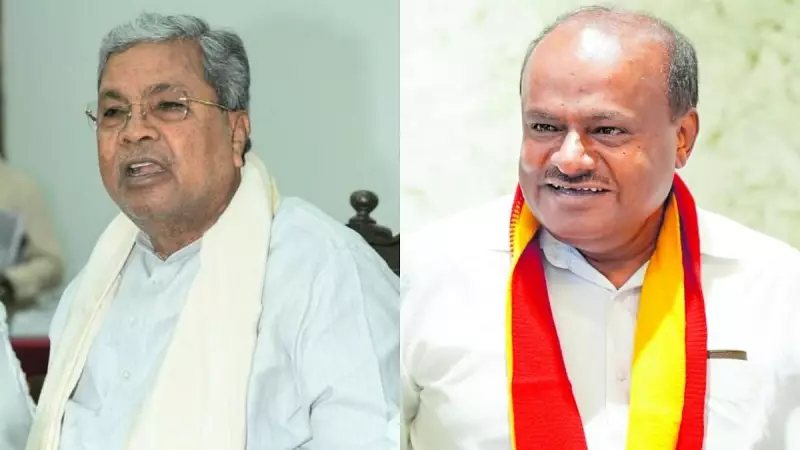
Karnataka Chief Minister Siddaramaiah has launched a sharp political attack against former CM and JD(S) leader H.D. Kumaraswamy, labeling him a 'Manuvadi'. The accusation came in response to Kumaraswamy's recent push for the inclusion of the Bhagavad Gita in the state's school curriculum.
The Core of the Controversy
The political firestorm ignited on December 6, 2025, when Siddaramaiah, while commemorating Dr. B.R. Ambedkar's contributions, directly addressed Kumaraswamy's advocacy for the religious text. The Chief Minister framed the demand not merely as an educational proposal but as an ideological battle. He juxtaposed Kumaraswamy's stance with the constitutional values championed by Babasaheb Ambedkar.
Invoking Ambedkar's Legacy
In his remarks, Siddaramaiah powerfully highlighted Dr. Ambedkar's monumental role in drafting the Constitution and his lifelong, relentless struggle to secure social justice for marginalized communities. The CM implied that the push for a specific religious text in the secular educational framework runs counter to these very principles. By using the term 'Manuvadi'—a reference to the ancient lawgiver Manu, whose codes are seen as emblematic of the caste hierarchy Ambedkar fought against—Siddaramaiah sought to paint his opponent's position as regressive and anti-constitutional.
Political Repercussions and Electoral Undertones
This exchange is more than a war of words; it signals a deepening of ideological fault lines in Karnataka's political landscape. The controversy touches upon sensitive issues of secularism, education policy, and social justice, which are potent themes ahead of any election cycle. Siddaramaiah's strategy appears to be consolidating his base by firmly anchoring his government's stance in the legacy of Ambedkar and positioning any opposition to it as opposing social equality itself. The debate over the Bhagavad Gita curriculum has thus been elevated from a policy discussion to a symbolic clash of worldviews.
The aftermath of this public labeling is likely to intensify the political discourse in the state. It forces other political players to clarify their stance on the intersection of religion and state education. Furthermore, it reaffirms the Congress government's commitment to a particular interpretation of secularism and social justice, setting the stage for future political confrontations on similar issues.