

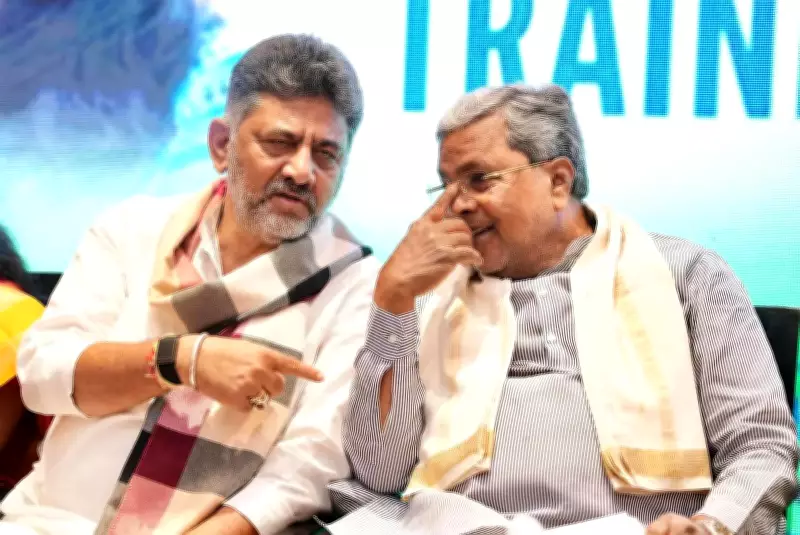
Bengaluru: In a fresh development for Chief Minister-elect DK Shivakumar, outgoing Chief Minister Siddaramaiah has reportedly proposed the formation of a coordination committee to act as a bridge between the Congress party and the government, reopening a debate over an ongoing power tussle within the Karnataka Congress.
While the proposal has yet to receive approval from the party high command, it places the brass in a delicate position. Siddaramaiah remains the party's tallest mass leader in Karnataka and cannot be politically sidelined, but the transition to Shivakumar is intended to be clear and decisive. However, a committee headed by Siddaramaiah could give him a formal role in governance and may fuel perceptions of dual power centres.
Analyst Views on the Proposal
MN Patil, a political analyst, said the committee's impact would depend on its powers. "If it is headed by Siddaramaiah and given substantial authority, it could emerge as a parallel decision-making structure. The challenge for Congress will be to ensure clarity on who exercises executive authority," Patil said.

Historical Context
Siddaramaiah had chaired a coordination and monitoring committee when the Congress-JD(S) coalition government, headed by Chief Minister HD Kumaraswamy, was at the helm in the state in 2018-19. The coalition government eventually collapsed in July 2019 after 16 MLAs resigned, reducing it to a minority. However, JD(S) functionaries, including former Prime Minister HD Deve Gowda and Kumaraswamy, accused Siddaramaiah of undermining the coalition, allegations he has consistently denied. Congress functionaries close to Siddaramaiah insist the government fell not because of the former CM or sabotage, but because of defections encouraged by the BJP.
Supporting and Opposing Views
A senior functionary who backed the proposal of a coordination committee said the panel would improve coordination between the party and government so that Shivakumar continues all the good work of his predecessor. He insisted it was not intended to interfere with the CM's functioning. However, functionaries aligned with Shivakumar privately acknowledge concerns that an ill-defined structure could complicate governance.
A senior Congress MLA from Tumakuru opposed the idea, saying the party's priority should be stability after a hard-fought leadership transition. "The focus should be on strengthening the new CM rather than creating additional centres of authority," he said.
Political Commentary
Political commentator Vishwas Shetty said the success of any such arrangement will depend entirely on its mandate. "If it functions as a consultative body, it can help manage internal differences. But if it begins exercising oversight over government decisions, comparisons with the 2018-19 coalition period will be inevitable," he said.
Shetty said the Congress high command may ultimately opt for an informal coordination mechanism or a limited advisory panel, allowing Siddaramaiah to remain politically relevant without diluting Shivakumar's authority.
About the Author: Manu Aiyappa has been with The Times of India for over two decades, currently serving as the Political Editor. His reporting focuses on politics, public policy, and in-depth features that aim to inform and engage a broad readership. Over the years, his work has been recognised by both the Press Club of Bangalore and the Karnataka Media Academy for its clarity, credibility, and relevance to public discourse.






