

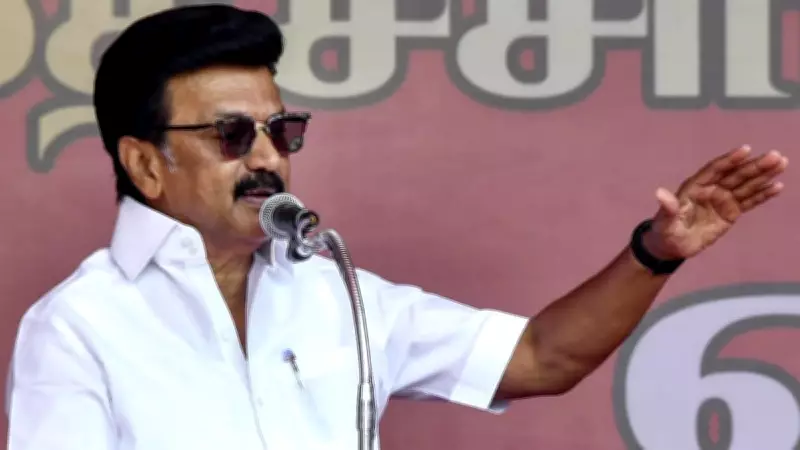
CM Stalin Accuses Centre of Using 3-Language Formula as 'Covert' Hindi Imposition
Tamil Nadu Chief Minister M K Stalin has made serious allegations against the central government, claiming that the three-language formula in the education system is a 'covert' mechanism designed to impose Hindi across India. As the president of the ruling Dravida Munnetra Kazhagam (DMK), Stalin asserted that the curriculum framework introduced by the Central Board of Secondary Education (CBSE), which aligns with the National Education Policy (NEP) 2020, is not an innocent academic reform but rather a strategic move with political undertones.
Allegations Against the National Education Policy 2020
Stalin emphasized that the NEP 2020, through its implementation by CBSE, serves as a tool for what he describes as linguistic hegemony. He argued that the policy's emphasis on a three-language formula, which typically includes Hindi, English, and a regional language, is being used subtly to promote Hindi at the expense of other Indian languages, particularly in non-Hindi speaking states like Tamil Nadu. This has reignited long-standing debates over language rights and federalism in the country.
Political and Educational Implications
The Chief Minister's statements highlight the ongoing tension between the central government's educational initiatives and regional aspirations. Stalin's critique points to concerns that such policies could undermine the cultural and linguistic diversity of India, potentially marginalizing non-Hindi speakers. He called for a reevaluation of the NEP 2020 to ensure it respects the pluralistic nature of Indian society and does not impose any single language.

This development comes amid broader discussions on education reform and language policy in India, with stakeholders from various states expressing similar apprehensions. The issue is expected to fuel further political discourse and could impact future policy adjustments at the national level.






