

Tamil Nadu Leaders Engage in Heated Exchange Over Minority Rights at Iftar Gatherings
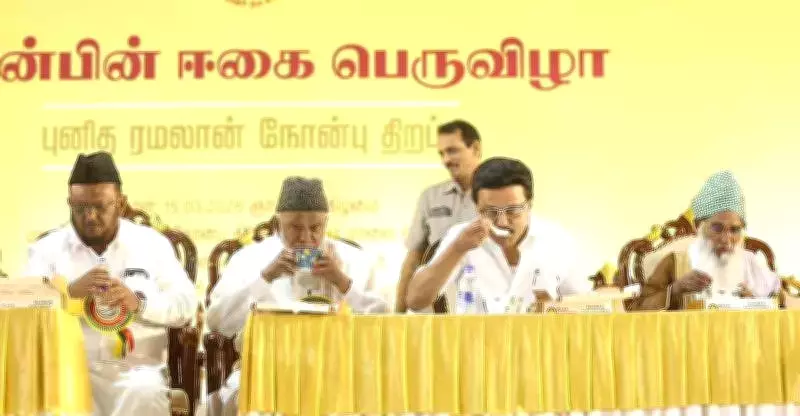
In a dramatic political showdown, Tamil Nadu Chief Minister M K Stalin and AIADMK general secretary Edappadi K Palaniswami attended separate Iftar feasts in Chennai on Sunday, sparking a fierce debate over minority rights and secular governance. The events highlighted deep divisions in the state's political landscape, with both leaders using the occasion to launch pointed criticisms at each other's records.
Stalin Accuses EPS of Silence on Minority Attacks
Speaking at a Ramzan Iftar event organized by the DMK minorities wing, Chief Minister Stalin launched a scathing attack on Edappadi K Palaniswami. He alleged that the AIADMK leader had remained conspicuously silent when minorities were targeted by mobs in various parts of the country. "EPS has mortgaged his conscience by aligning with forces that spread hatred against minorities," Stalin declared, his voice resonating with conviction.
Stalin further elaborated on his accusations, pointing to specific incidents. "He was silent when Christians were attacked during Christmas across the country. How can he safeguard minority rights while continuing his ties with the BJP?" he questioned, challenging EPS's commitment to secular values. The Chief Minister emphasized the DMK's longstanding relationship with the Muslim community, asserting that his party has consistently raised its voice for minority rights, both in opposition and in government.

"When minorities face trouble, some leaders run and hide. DMK is always the first to speak up for their rights," Stalin stated, reinforcing his party's proactive stance. He portrayed the DMK as a steadfast defender of marginalized communities, contrasting it with what he described as the AIADMK's passive approach.
EPS Defends AIADMK's Secular Credentials
In a parallel Iftar feast attended by BJP state president Nainar Nagenthran and AMMK general secretary TTV Dhinakaran, Edappadi K Palaniswami fired back at Stalin's allegations. He accused the DMK and its allies of attempting to create a false impression that they are the sole guardians of minority rights. "In reality, it is the AIADMK that safeguards minorities," EPS asserted, standing firm on his party's principles.
EPS outlined the AIADMK's core values, emphasizing a commitment to secularism, social harmony, and firm law-and-order-based governance. "Under no circumstances would AIADMK deviate from its core principles," he vowed, addressing the gathered crowd. He invoked the legacies of former leaders M G Ramachandran and J Jayalalithaa, promising to follow their path in providing governance that benefits all sections of society.
"Following the path shown by Puratchi Thalaivar and Amma, we will provide governance that benefits everyone," EPS said, highlighting the AIADMK's historical role in promoting inclusive policies. His remarks aimed to counter the DMK's narrative, positioning the AIADMK as a party with a proven track record of protecting minority interests without compromising on governance standards.
Political Implications and Broader Context
The exchange between Stalin and EPS underscores the intensifying political rivalry in Tamil Nadu, with minority rights emerging as a central issue. Key points from their speeches include:
- Stalin's criticism of EPS's alliance with the BJP and perceived silence on national incidents of minority targeting.
- EPS's defense of the AIADMK's secular ethos and governance model, distancing it from the DMK's accusations.
- The use of Iftar events as platforms for political messaging, reflecting the significance of religious and cultural gatherings in state politics.
This clash comes at a time when national debates on secularism and minority protection are gaining momentum, making the Tamil Nadu leaders' statements particularly resonant. Both parties are likely to leverage these positions in upcoming electoral battles, aiming to consolidate support among diverse voter bases.

As the political discourse evolves, the focus remains on how these leaders will translate their promises into actionable policies for minority communities. The events in Chennai serve as a reminder of the ongoing struggle for representation and rights in India's democratic framework.





