Tamil Nadu CM Stalin Announces State-Wide Black Flag Protest Against Centre's Delimitation Plan
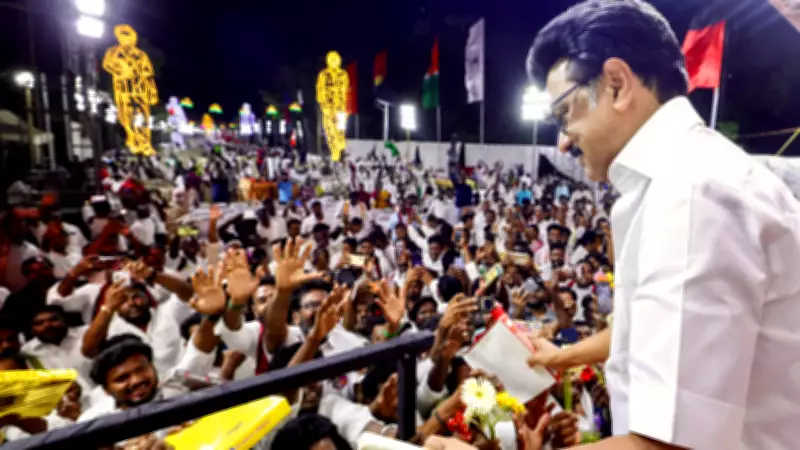
The political confrontation between the Central government and the Tamil Nadu administration has intensified dramatically, with Chief Minister M K Stalin declaring a comprehensive state-wide black flag protest scheduled for Thursday. Stalin has accused the Union government of advancing a proposal that could significantly diminish Tamil Nadu's political influence within India's federal structure.
A Broader Battle for Southern States
Characterizing the dispute as a larger conflict between southern states and the Centre, Stalin issued a stern warning that the Bharatiya Janata Party-led government would face severe political repercussions if it disregarded Tamil Nadu's concerns. Following an urgent meeting with DMK Members of Parliament and district secretaries, Stalin described the proposed delimitation exercise as presenting a "grave danger," comparing it to a long-anticipated threat that has now become reality.
Labeling the Centre's approach as deliberately confrontational, Stalin announced that black flags would be raised throughout Tamil Nadu as a powerful symbol of resistance and dissent. He further cautioned that if the Union government refused to reconsider its position, it would encounter substantial political consequences that could reshape national dynamics.

"This struggle transcends party affiliations; it is fundamentally about safeguarding the rights and representation of our people," Stalin emphasized, appealing to parliamentarians across India to unite in defense of federal principles and equitable representation.
Understanding the Delimitation Controversy
Delimitation refers to the constitutional process of revising electoral constituency boundaries and reallocating Lok Sabha seats among states according to population changes. Article 82 of the Constitution mandates that this exercise should follow each Census. Currently, the Lok Sabha comprises 543 elected members, though constitutional provisions allow for up to 550 seats. The Central government now proposes to expand this capacity to 850 seats—815 allocated to states and 35 to Union Territories.
The existing seat distribution remains anchored to the 1971 Census data, as delimitation has been suspended for decades to prevent penalizing states that achieved successful population control. However, the proposed constitutional amendment aims to lift this freeze and initiate fresh delimitation based on the 2011 Census data.
Government officials contend that India's demographic landscape has transformed substantially, with migration patterns, urbanization trends, and uneven population growth creating significant disparities in political representation. Additionally, the delimitation process is crucial for implementing the 33% reservation for women in Parliament and state assemblies established under the 2023 legislation.
Stalin's Opposition and Broader Coalition Building
Stalin has positioned himself as one of the most vocal critics of the Centre's delimitation initiative, denouncing it as systematically biased against South Indian states. He argues that population-based seat redistribution would inevitably reduce the political weight of southern states like Tamil Nadu, which have excelled in population management, while disproportionately enhancing representation for northern states with higher population increases.
Stalin maintains that this approach effectively penalizes states that demonstrated superior performance on development indicators, transforming delimitation into what he terms a "historic injustice." He has warned that the proposal could exacerbate the North-South divide and fundamentally distort India's federal architecture.
The Tamil Nadu Chief Minister has expressed concerns that the shift could disproportionately concentrate parliamentary power in northern states, thereby weakening the South's voice in critical national decision-making processes. By framing the issue beyond partisan politics, Stalin is actively rallying non-BJP ruled states and advocating for a united opposition front, cautioning that protests and political consequences will escalate if the Centre proceeds without achieving broad consensus.

Stalin has previously threatened large-scale protests capable of bringing the state to a standstill, invoking the DMK's historical legacy of mass agitations during the 1950s and 1960s concerning state rights and autonomy. He has been coordinating extensively with leaders of other non-BJP governed states, including Kerala Chief Minister Pinarayi Vijayan and Telangana Chief Minister Revanth Reddy, as part of strategic efforts to construct a broader coalition opposing the Centre's proposal.