

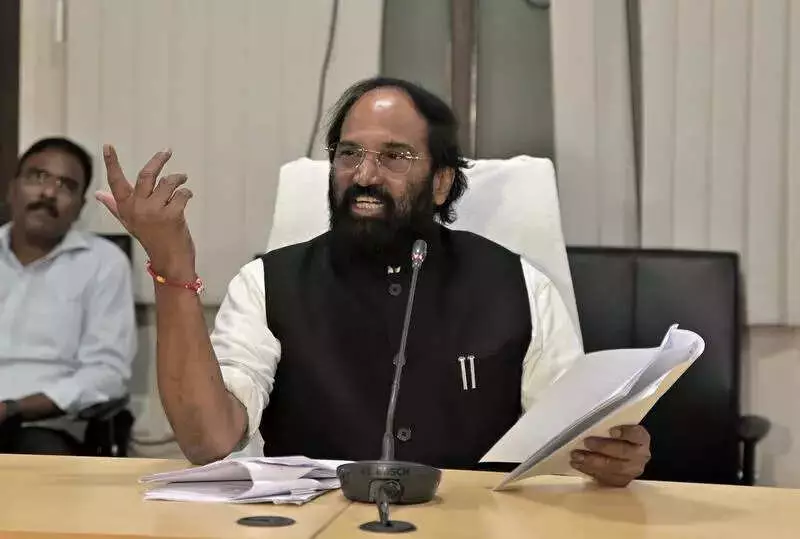
In a significant escalation of the inter-state water dispute, Telangana's Irrigation Minister, N Uttam Kumar Reddy, has strongly countered allegations made by former minister and BRS leader T Harish Rao regarding the Polavaram-Banakacherla link project. The minister accused the opposition leader of spreading falsehoods and detailed the state government's legal offensive in the Supreme Court.
Legal Battle Reaches the Apex Court
The Telangana government has taken the contentious issue of the Polavaram project expansion to the highest judicial forum. The state filed a writ petition in the Supreme Court in the third week of December 2023. This petition is scheduled for its first hearing on January 5, 2026, before a bench headed by the Chief Justice of India.
Minister Uttam Kumar Reddy, in an official release issued on Tuesday evening, stated that this legal action proves the state is aggressively challenging the project. He labeled Harish Rao's press conference claims as "completely false," asserting that the BRS leader continues to peddle lies about the government's stance on the irrigation issue.

Core Demands of Telangana's Petition
The state's petition to the Supreme Court outlines several critical requests aimed at stalling the neighboring state's plans. Primarily, Telangana has urged the court to:
- Restrain the Andhra Pradesh government from preparing the Detailed Project Report (DPR) for the expanded Polavaram project.
- Prohibit Andhra Pradesh from undertaking any expansion works related to the Polavaram-Banakacherla (Nallamalla Sagar) link project.
- Direct central agencies, including the Central Water Commission (CWC), the Union Jal Shakti Ministry, and the Godavari and Krishna River Management Boards, from granting any clearances or approvals for the project.
Furthermore, the petition seeks orders to stop these central bodies from appraising any Pre-Feasibility Reports (PFRs) or DPRs and from releasing funds for the contested link project.
Allegations of Violations and Unilateral Expansion
Telangana's legal challenge is built on the argument that Andhra Pradesh's actions violate established laws and agreements. The petition contends that the Polavaram-Banakacherla link project is proposed against the provisions of the Andhra Pradesh State Reorganisation Act of 2014. It also alleges violations of tribunal awards governing inter-state water sharing disputes.
The central accusation involves a massive escalation in the project's scope. According to the Telangana government, the original Polavaram project was approved to utilize 80 thousand million cubic feet (tmc ft) of water to be diverted to the Krishna basin via a canal system, while also serving its command area in the Godavari basin.
However, the petition alleges that the Andhra Pradesh government is now expanding the Polavaram project's infrastructure to carry a staggering 200 tmc ft of water, all without securing the necessary approvals, as part of the new link project.
Telangana has informed the Supreme Court that Andhra Pradesh has already initiated the process for these expansion works. The state pointed out that the link project's PFR was submitted to the CWC, and without waiting for the in-principle consent from the CWC—a mandatory prerequisite for preparing a DPR—the AP government has floated tenders and is in the process of awarding contracts soon.
The petition argues that the very act of the CWC appraising the PFR is a violation of its own guidelines, making the process legally untenable.
Political Crossfire and the Road Ahead
The development has ignited a fresh political war of words in Telangana. The Congress government, represented by Minister Uttam Kumar Reddy, is positioning itself as a defender of the state's water rights through legal means. In contrast, the opposition BRS, through Harish Rao, has accused the government of not doing enough to protect Telangana's interests.

With the Supreme Court hearing set for January 2026, the issue is poised to remain a flashpoint in both state politics and inter-state relations. The legal outcome could have far-reaching implications for water resource management and infrastructure development in the Godavari and Krishna basins, setting a precedent for how such disputes are adjudicated in the future.





