In a significant escalation of an inter-state water dispute, the Telangana government has approached the Supreme Court of India seeking to stop neighbouring Andhra Pradesh from moving forward with the contentious Polavaram-Nallamala Sagar link project. The legal move, initiated through a writ petition filed on Tuesday, aims to prevent Andhra Pradesh from preparing a detailed project report (DPR) and expanding the Polavaram project's capacity.
Core of the Legal Challenge
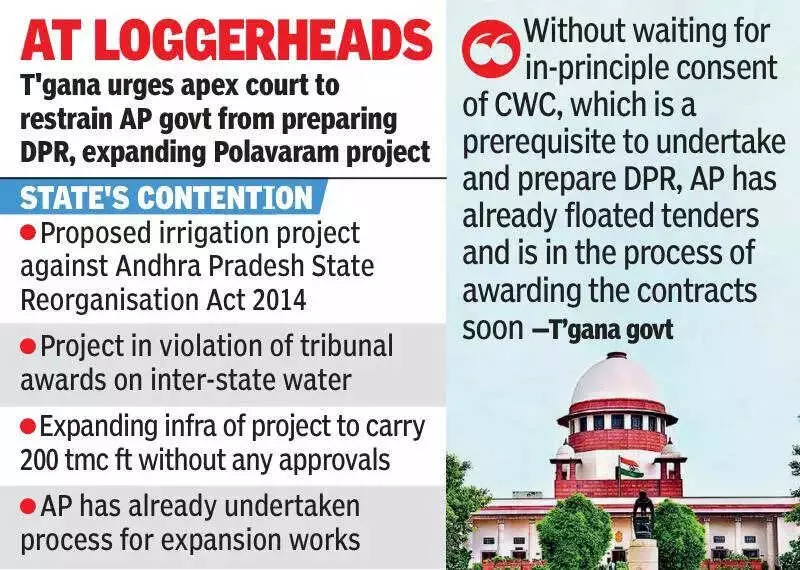
The petition urges the apex court to issue a restraining order against the Andhra Pradesh government. Furthermore, it seeks directives for central government agencies, including the Central Water Commission (CWC), the Union Ministry of Jal Shakti, and the Godavari and Krishna River Management Boards, to withhold any appraisals or clearances for the project. Telangana has argued that the AP government is proceeding without securing the mandatory in-principle consent from the CWC, a prerequisite for preparing a DPR.
According to the Telangana government's submission, the Andhra Pradesh administration has already floated tenders and is in the process of awarding contracts for the link project. This action, Telangana contends, is being undertaken even before the CWC has appraised the project's pre-feasibility report (PFR), which it claims is a violation of the Commission's own guidelines.

Allegations of Violations and Over-expansion
At the heart of the conflict lies the allegation that the Polavaram-Nallamala Sagar link project (formerly known as the Polavaram-Banakacherla link) contravenes the Andhra Pradesh State Reorganisation Act of 2014 and violates existing tribunal awards on the sharing of inter-state river waters. The Telangana government stated that the original Polavaram project was approved to transfer 80 thousand million cubic feet (tmc ft) of water from the Godavari basin to the Krishna basin via a canal system.
However, the petition alleges that Andhra Pradesh is now expanding the Polavaram project's infrastructure to carry a staggering 200 tmc ft of water as part of the new link project. This three-fold increase, Telangana argues, is being pursued without any necessary approvals and represents a significant threat to Telangana's rightful share of water.
Political Efforts Preceding Legal Action
The filing of the writ petition follows a series of high-level political engagements that failed to resolve the impasse. Both Telangana Chief Minister A. Revanth Reddy and state Irrigation Minister N. Uttam Kumar Reddy had previously met with Union Jal Shakti Minister C.R. Patil and had written formal letters outlining their objections. Despite these efforts, the perceived lack of action to halt Andhra Pradesh's progress compelled the Telangana government to seek judicial intervention.
The state's petition emphasises that the AP government's actions violate the fundamental rights of the people of Telangana by jeopardising their water security. It also points to a technical discrepancy, noting that while CWC guidelines mandate the appraisal of projects based on 75% dependable flow (as per the Godavari Water Disputes Tribunal award), the AP government's plans allegedly disregard this standard.
With the matter now before the Supreme Court, this legal battle marks a critical juncture in the long-standing water sharing tensions between the two Telugu states. The outcome will have profound implications for irrigation, drinking water projects, and agricultural planning in both regions.