

Nearly ten years after Telangana reshaped its administrative landscape, the state government is gearing up to reconsider one of its most ambitious decisions. The creation of new districts, revenue divisions, and mandals in 2016 is now under scrutiny.
Growing Consensus for Change
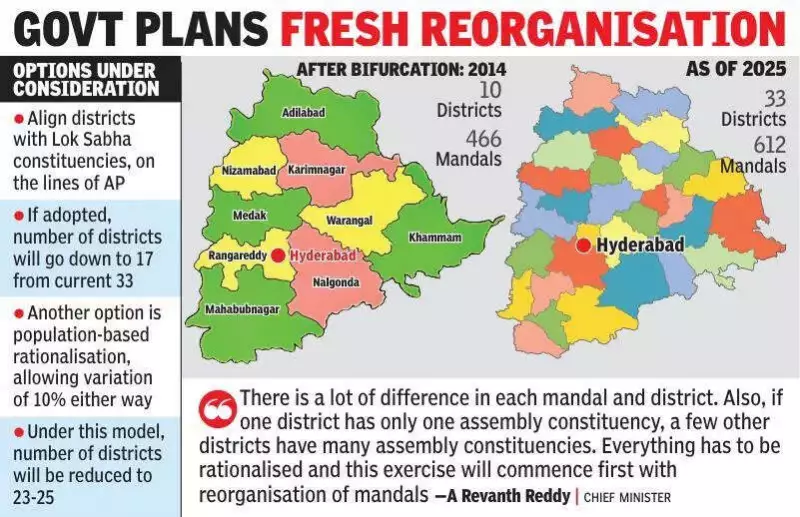
Officials within the government widely agree that the 2016 expansion was rushed and lacked proper groundwork. This move increased the number of districts from 10 to 33 and mandals from 466 to 612. Many believe the exercise, carried out by the previous BRS government, created uneven administrative units. These units have complicated governance instead of improving it.
Residents now face difficulties accessing officials for grievance redressal. Elected representatives and bureaucrats struggle with fragmented jurisdictions and overlapping authority. The situation has prompted calls for a course correction.

Specific Anomalies Trigger Demands
Several issues have sparked renewed demands for changes. Husnabad, once part of Karimnagar district, now falls under Siddipet. However, the constituency spans three districts: Siddipet, Karimnagar, and Hanumakonda. This has led to calls for merging Husnabad back with Karimnagar.
In Warangal, local leaders demand the merger of Warangal and Hanumakonda districts. They argue the split diluted the region's administrative identity. The erstwhile Mahabubnagar district was divided into five districts: Mahabubnagar, Wanaparthy, Jogulamba Gadwal, Nagarkurnool, and Narayanpet. This division added to administrative complexity.
Potential Mergers and Splits
The government is also considering whether to split Hyderabad district into Hyderabad and Secunderabad. Smaller districts are under scrutiny as well. Gadwal, Wanaparthy, and Narayanpet may merge with adjoining districts.
Jayashankar Bhupalpally and Mulugu could combine into a single district. Jangaon and Yadadri might merge elsewhere. Speculation suggests Siddipet could join Sangareddy or Medak, while Rajanna Sircilla might merge with Karimnagar.
Committee Formation Announced
Chief Minister A Revanth Reddy announced on Monday that the government will form a committee. This committee will be headed by a retired high court or Supreme Court judge. Senior officials will also participate. The committee will study the issue and submit recommendations.
Revanth Reddy stated the previous government created districts in an unscientific and irrational manner. The new committee aims to address these concerns.
Two Broad Options Under Consideration
Government sources reveal two main proposals are being evaluated. The first option involves aligning districts with Lok Sabha constituencies, similar to Andhra Pradesh. Officials believe this would resolve many administrative overlaps.
If adopted, the number of districts could drop sharply from 33 to 17. Mandals might reduce to between 550 and 575. Notably, the 2016 expansion did not include additional staff recruitment. Existing personnel were merely redistributed, straining administrative capacity.
MLAs have urged the government to ensure each assembly segment falls within a single district. This would enable smoother coordination with one district collector, easier access to funds, and participation in a single zilla parishad.
Population-Based Rationalization
The second option considers population-based rationalization, allowing a 10 per cent variation. Under this model, the number of districts would reduce to around 23-25.
According to the 2011 Census, several districts have populations close to five lakh. These include Bhupalpally, Jangaon, Asifabad, Sircilla, Wanaparthy, and Narayanpet. Mulugu has the lowest population at 2.94 lakh.
Ground Realities Ignored
Persistent allegations claim district boundaries were drawn without accounting for ground realities. Some districts are barely 45-50 km apart. For instance, Mulugu and Bhupalpally are separated by just 45 km, as are Jangaon and Yadadri.
A senior official highlighted challenges. The government must use the 2011 Census as the basis since the 2026 census will be completed this year. Additionally, several permissions and a no objection certificate are required from the Centre.
The upcoming review aims to create a more efficient and manageable administrative framework for Telangana.






