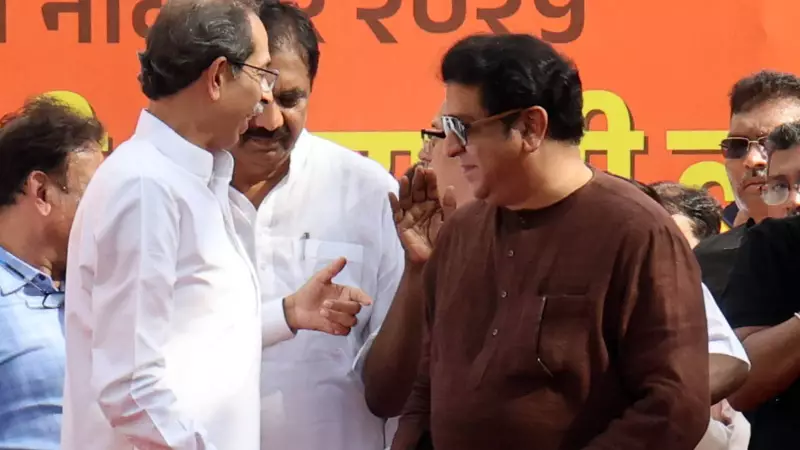
The political landscape of Maharashtra has been jolted by a significant development: the formal announcement of an alliance between Uddhav Thackeray's Shiv Sena (UBT) and Raj Thackeray's Maharashtra Navnirman Sena (MNS) for the upcoming Mumbai Municipal Corporation elections. This move, reuniting the politically estranged Thackeray cousins, is widely seen as a crucial attempt to consolidate opposition forces against the ruling Bharatiya Janata Party (BJP) and its allies.
A Strategic Union Forged in Opposition
The groundwork for this alliance was laid recently when both parties jointly opposed the Fadnavis government's decision to introduce compulsory Hindi in primary schools. Their successful campaign in forcing the government to retreat on this issue demonstrated their combined strength and convinced their support bases of the alliance's potential. The announcement, made on December 25, 2025, marks the most notable political shift in the state in over a year, especially following the disintegration of the Maha Vikas Aghadi (MVA) coalition after its poor performance in the last assembly elections.
With the Congress party blaming its alliance with Shiv Sena (UBT) for its historic electoral defeat and even considering going solo in Mumbai, the broader opposition front lay in tatters. The Thackeray cousins' pact has now informally buried the MVA, although speculations suggest that Sharad Pawar's NCP (SP) could still join this new front. However, Sharad Pawar's party faces its own existential crisis, with Ajit Pawar's faction, part of the ruling alliance, making significant gains in local body polls and positioning itself as a credible opposition force for the future.

The Mumbai Battleground and Electoral Calculus
The immediate test for the UBT-MNS combine is the Mumbai civic polls. A victory here for the opposition could dramatically alter the state's political narrative and offset the ruling coalition's gains elsewhere. Analysts recall the 2017 Mumbai corporation election, where a united Shiv Sena narrowly defeated the BJP, which was a close runner-up. Today, Uddhav Thackeray's party, diminished by Eknath Shinde's rebellion, hopes to recoup losses by joining forces with Raj.
However, the alliance faces a multi-pronged challenge. The BJP's aggressive blend of Hindutva and development politics has cornered Uddhav. For Raj Thackeray, the test is even starker, as his core Marathi middle-class support base significantly overlaps with pro-Narendra Modi voters. The cousins are attempting to win this constituency back by emphasizing a Mumbai-Marathi-Maharashtra plank. Yet, even if they consolidate a large portion of Marathi votes (approximately 40% of the electorate), securing minority community support is not guaranteed.
The Shifting Allegiances of Minority Voters
A critical factor in the upcoming contest is the tactical voting pattern of minority communities. Minorities in Maharashtra are increasingly voting not merely to defeat the BJP, but to ensure the political relevance of their local leaders. These leaders are now forging pragmatic alliances with the Shinde-led Shiv Sena and Ajit Pawar's NCP to get administrative work done at the district level. This trend enhances Eknath Shinde's importance in Mumbai's complex electoral algebra and could dent the opposition alliance's prospects.
Under these adverse conditions, the primary challenge for the Uddhav-Raj partnership is to project stability and longevity. They must convince voters that their alliance is a durable alternative, whether facing a narrow victory or a decisive defeat. With the BJP's national leadership indicating intentions to contest future state elections independently, and Ajit Pawar building his own power base, the Thackeray cousins' alliance represents a desperate bid to retain political relevance in a rapidly evolving Maharashtra.