

Thackeray Brothers Sound Alarm Over 'Gujarati Takeover' of Mumbai
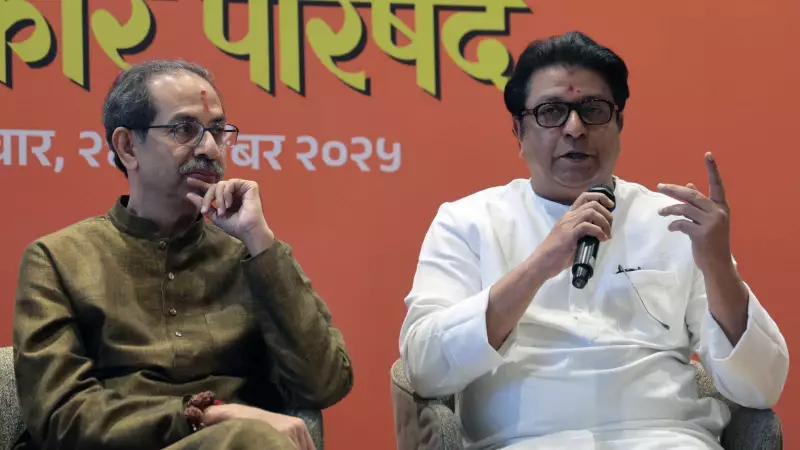
Uddhav Thackeray and Raj Thackeray have joined forces for the Brihanmumbai Municipal Corporation elections. Their alliance marks a significant political shift in Maharashtra. The cousins held their first joint rally in Mumbai after nearly two decades. They delivered a stark warning to the city's Marathi-speaking population.
'Mumbai at Risk of Being Handed Over to Gujarat'
Raj Thackeray, who leads the Maharashtra Navnirman Sena, made bold claims at the Sunday night rally. He alleged a deliberate plan to detach Mumbai from Maharashtra. "The plan was always to snatch Mumbai from Maharashtra and attach it to Gujarat," Raj declared. He accused certain forces of using money and land purchases to achieve this goal.
"They are buying land, settling people here and electing their representatives," Raj continued. "Grabbing the land is a long-term plan. Land and language are your identity. Once it is gone, your identity is over."

Uddhav Thackeray echoed similar concerns in a recent interview. The Shiv Sena (UBT) president linked the issue to BJP's political maneuvers. "After Balasaheb Thackeray passed away in 2012, the BJP's top leadership, largely Gujarati, wanted to stake a claim on Mumbai," Uddhav stated. He clarified that ordinary Gujaratis living in Mumbai have no role in this politics.
BJP Counters With 'Fake Narrative' Accusation
Maharashtra Chief Minister Devendra Fadnavis quickly dismissed the Thackerays' claims. He labeled their warnings a "fake narrative" created for electoral gain. "In Mumbai, there is no such divide based on communities," Fadnavis asserted. "Nobody can undermine Mumbai's significance nor break it from Maharashtra."
BJP leaders pointed to historical contradictions in the Thackerays' position. They recalled how the undivided Shiv Sena once actively courted Gujarati voters. During the 2014 and 2019 elections, the party organized special outreach events. They even displayed posters saying "Jalebi fafda, Thackeray aapda" in Gujarati neighborhoods.
State BJP president Ravindra Chavan suggested the Thackerays feel threatened. "They are uneasy about the BJP's expansion in Maharashtra," Chavan explained. "Our party has found acceptance among Marathis, the traditional vote bank of Sena and MNS."
Historical Roots of the Linguistic Divide
The fear of Mumbai slipping from Maharashtra's control has deep historical roots. It dates back to the linguistic states movement of the mid-20th century. When demands for language-based states gained momentum, Bombay became a major flashpoint.
A powerful group of Gujarati-speaking businessmen formed the Bombay Citizens Committee. Led by cotton magnate Sir Purushottamdas Thakurdas, they opposed Bombay's inclusion in Maharashtra. Their arguments centered on three main points:
- Bombay was a multilingual, cosmopolitan city
- Marathi speakers did not constitute an absolute majority
- The city was geographically distinct from the Marathi heartland
The Samyukta Maharashtra movement emerged as a counterforce. It brought together Congress leaders, socialists, Communists, and Dalit activists. They argued that Bombay depended on Maharashtra for essential resources. Separating the city would permanently weaken Marathi political and economic power.
The Long Struggle for a United Maharashtra
The central government initially resisted creating linguistic states. Prime Minister Jawaharlal Nehru feared they would deepen regional divisions. The States Reorganisation Commission proposed a bilingual Bombay state in 1956. This recommendation sparked widespread anger across Maharashtra.
Political pressure mounted steadily. Several Maharashtrian leaders resigned from the Congress in protest. The agitation continued despite various compromise proposals. By the late 1950s, governing Bombay without addressing Marathi sentiment became impossible.
On May 1, 1960, the Centre finally created separate states of Maharashtra and Gujarat. Bombay became the capital of Maharashtra, ending years of political struggle.

Political Tool for Generations of Thackerays
The Shiv Sena, founded in 1966, inherited this legacy of linguistic politics. Bal Thackeray's father, Prabodhankar Thackeray, had actively participated in the Samyukta Maharashtra movement. He linked the struggle with Marathi identity and self-respect through his writings.
The Sena repeatedly used the outsider threat message to tap into identity anxieties. This approach proved particularly effective during the 1985 BMC elections. Then Chief Minister Vasantdada Patil had remarked that "Mumbai may be in Maharashtra, but I don't see Maharashtra in Mumbai."
The Sena turned this statement into a major campaign issue. They framed the civic elections as a battle for Mumbai's Marathi identity. The strategy worked brilliantly. The party won 74 of the 139 seats it contested and gained control of the BMC.
Current Political Calculations
Now, the Thackeray brothers hope to repeat this successful formula. Their alliance represents an attempt to consolidate the Marathi vote bank. By raising the Gujarati takeover fear, they aim to create a unifying narrative.
The BJP, meanwhile, presents itself as a party for all communities. "Whether it is Gujaratis, Marathis, or North Indians, everyone has voted for the BJP," Ravindra Chavan emphasized. Senior BJP MLA Parag Alavani questioned the sudden emergence of this divide. "When the undivided Shiv Sena was in alliance with the BJP for three decades, this issue never came up," he noted.
As Mumbai prepares for crucial civic polls, old anxieties have resurfaced. The Thackeray brothers' warnings about identity and control echo through the city's political landscape. Their alliance represents both a family reunion and a strategic calculation. The outcome will reveal whether this decades-old political tool still retains its potency.





