At a crucial pre-Budget meeting with the Union government, Tamil Nadu's Finance Minister, Thangam Thennarasu, issued a stark warning about the economic challenges facing the state. He highlighted that external trade shocks and unresolved fiscal issues with the Centre are putting millions of livelihoods and key development projects in jeopardy.
Mounting Trade Threats and Employment Crisis
The minister devoted significant attention to the impact of recent international trade policies, particularly tariff hikes by the United States. With 31% of Tamil Nadu's goods exports destined for the US market, the state's export-driven economy is uniquely vulnerable.
Thennarasu singled out the textile sector, a massive employer in the state, for special concern. Tamil Nadu accounts for 28% of India's textile exports and provides employment to more than 75 lakh workers. He warned that if current conditions persist, an estimated 30 lakh jobs are at immediate risk, with many Micro, Small, and Medium Enterprise (MSME) units facing potential closure.

To counter this, the state has called for a dedicated support package for the textile industry. The proposed measures include interest subvention, targeted subsidies, export incentives, and appropriate tax relief to help the sector weather the storm.
Persistent Fiscal Frictions with the Centre
Beyond global trade, the minister presented a detailed case against what Tamil Nadu perceives as delayed project funding and shrinking revenues. A major point of contention is the Chennai Metro Rail Phase-II Project, approved by the Union government in October 2024.
Thennarasu revealed that even after one and a half years, the state has not received the full benefit of this approval. Tamil Nadu has already advanced approximately Rs 9,500 crore towards the Centre's share of the project. This accounting discrepancy, he argued, distorts the state's debt-to-GSDP ratio and artificially reduces its permissible borrowing limit. He urged the Centre to correct the budget entries in line with the original Cabinet approval.
The minister also requested a revisit of metro rail proposals for Madurai and Coimbatore, stating that the grounds for their rejection seemed inconsistent with approvals granted to other cities.
GST Shortfalls and Shrinking State Revenues
The issue of Goods and Services Tax (GST) compensation was raised forcefully. Thennarasu reiterated that GST was introduced under the promise of cooperative federalism, with states giving up fiscal autonomy on the assurance of protected revenues. He contended that this assurance has weakened.
For Tamil Nadu alone, the estimated GST revenue loss in the current financial year is about Rs. 10,000 crore. The minister urged the Union government to restore a permanent compensation mechanism to address such persistent shortfalls. He also criticised the Centre's increasing use of cesses and surcharges, which generate revenue solely for the central exchequer, depriving states of their constitutionally mandated share.
Stalled Welfare Schemes and Infrastructure Delays
The state government flagged several centrally sponsored schemes where funding delays or revised patterns are creating additional burdens. Regarding the Viksit Bharat–Guarantee for Rozgar and Ajeevika Mission, the revised funding formula is estimated to impose an additional burden of around Rs. 5,000 crore on Tamil Nadu.
Thennarasu highlighted stalled fund releases under critical welfare programmes:

- Jal Jeevan Mission: No funds have been released since September 2024. Tamil Nadu is seeking the immediate release of Rs 3,112 crore.
- Hogenakkal Water Supply Project Phase III: The Centre's refusal to provide Rs 2,283 crore has delayed the project's financial closure.
- Samagra Shiksha Scheme: The Union government has not released its approved share for 2024-25 and 2025-26, amounting to Rs 3,548 crore, affecting 44 lakh students and 2.4 lakh teachers.
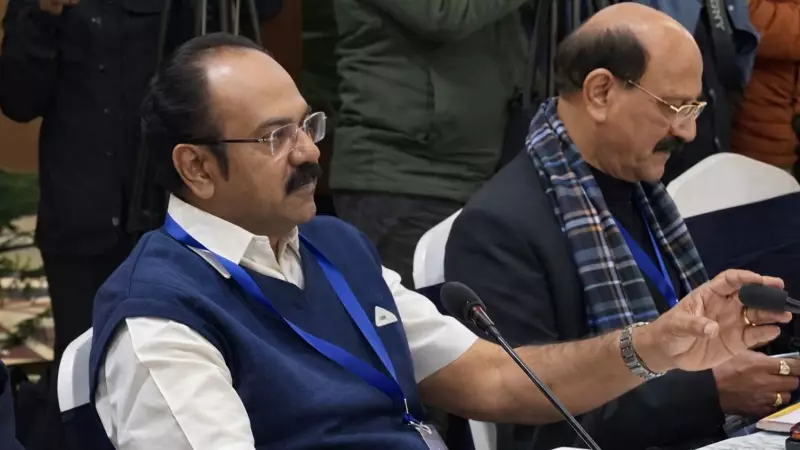
In his concluding remarks, the Finance Minister sought new railway investments in industrial corridors, a semi-high-speed rail link connecting Chennai, Salem, and Coimbatore, and priority funding for national highway projects. The meeting, chaired by Union Finance Minister Nirmala Sitharaman, underscored the ongoing fiscal tensions between the state and the Centre amidst a challenging global economic environment.