

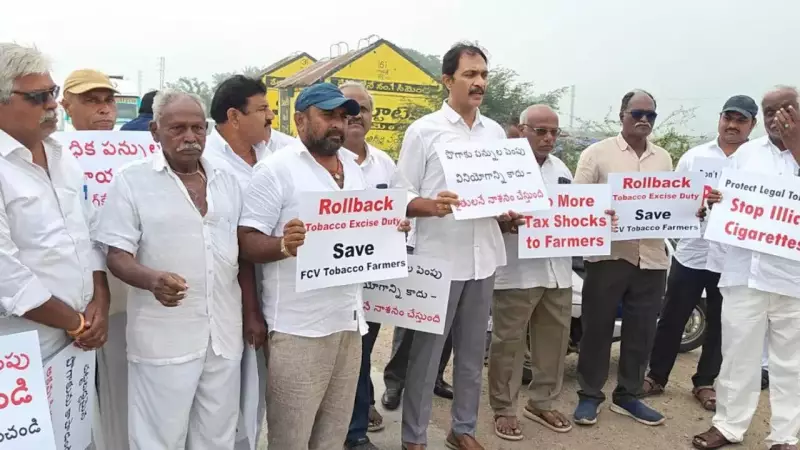
Thousands of tobacco farmers from Andhra Pradesh and Karnataka have taken to the streets in a series of intense protests, demanding the central government immediately withdraw a recent and excessive hike in taxes on tobacco products. The farmers argue that the move violates earlier assurances of a revenue-neutral shift and threatens to destroy their livelihoods while encouraging a parallel illegal market.
Widespread Agitation and Road Blockades
Angry farmers staged rasta rokos (road blockades), dharnas (sit-ins), and rallies across multiple districts in both states. Their primary grievance targets the Centre's unilateral decision to impose massive new taxes, which they claim was enacted without considering the severe impact on the agricultural community. The protests were organized under the banner of the Federation of All India Farmer Associations (FAIFA), which has reacted sharply to the government's notification on new duty rules for chewing tobacco, Jarda scented tobacco, and gutkha packing machines.
FAIFA's Stern Warning: Glut, Discrimination, and Smuggling
FAIFA has expressed deep concern that the steep tax increase contradicts government statements about a revenue-neutral transition from the compensation cess regime. The federation warns that this will force domestic manufacturers to raise prices, leading to a drop in legal sales. This decline will directly hurt farmers by reducing demand for their supplies, potentially causing a glut in the tobacco crop market in the near future.

In a strong statement, FAIFA president Murali Babu highlighted what he called an openly discriminatory tax regime against FCV (Flue-Cured Virginia) tobacco growers from Andhra Pradesh and Karnataka. He pointed out that FCV tobacco, used in cigarettes, is already taxed over 50 times more per kg than tobacco used for bidis and over 30 times more than for chewing tobacco.
"Further, while FCV tobacco attracts more than ₹6 in tax per dose in the finished product, other tobacco forms used in bidis and chewing products are taxed at less than one paisa per dose," Babu said. "Such extreme disparity punishes the most regulated and compliant farmers. The current steep excise hike is further widening this fiscal discrimination and will crush FCV growers and distort the entire tobacco economy."
Broken Promises and the Threat of an Illicit Boom
The farming community feels betrayed, citing the government's assurance during the GST 2.0 announcement in September. At that time, it was stated that for tobacco products, GST would be charged at 40% of the retail price, with the overall tax burden remaining unchanged. "We are shocked to see that the promise has not been kept, and instead a sharp increase in taxes has been notified, at the cost of farmers' livelihoods," lamented Murali Babu.
FAIFA leaders stressed that India's legal cigarettes are already among the least affordable globally when measured against per capita income, as per the WHO's affordability index. The current hike will make legal products unaffordable for a vast section of consumers, accelerating migration to illegal channels.
The body issued a stark warning, noting that India is already the fourth-largest illicit cigarette market globally, with illegal products constituting about 26% of total consumption. This situation, driven by tax arbitrage, will worsen dramatically with the new hike, leading to significant revenue losses for the government and overwhelming enforcement agencies.
FAIFA has urgently called on the government to roll back the notified excise rates and revise them to revenue-neutral levels. They argue that a stable taxation framework is essential to sustain farmer incomes, protect employment across the value chain, and ensure economic policy aligns with long-term public health goals without crippling the legal industry.






