

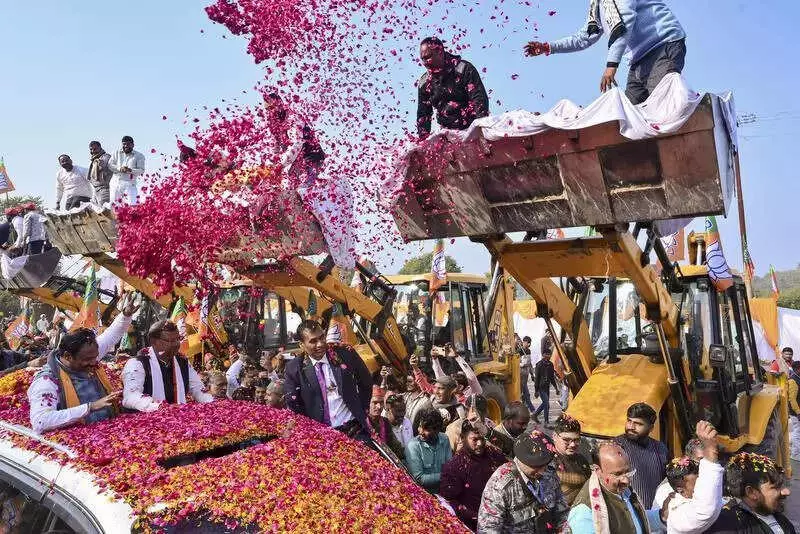
In a clear strategic move, newly appointed Uttar Pradesh BJP chief Pankaj Chaudhary chaired a crucial meeting of party functionaries in Ayodhya on Monday. This gathering aimed to mobilize both the party cadre and voters across the core centers of the BJP's six organizational regions. The timing is significant, coming just ahead of the upcoming panchayat and state assembly elections.
Ayodhya: The Ideological Heart of the Mobilization
Ayodhya, widely recognized as the ideological center of the BJP's Hindutva politics, falls under the Awadh region. This region encompasses 15 organizational districts, including the state capital Lucknow. It holds 82 assembly seats and 16 Lok Sabha constituencies, making it a critical electoral battleground.
Party sources reveal that Chaudhary deliberately chose Ayodhya for this meeting. The choice sends a powerful message that ideology remains central to the BJP's political mobilization efforts, even as the party emphasizes good governance. Chaudhary traveled to Ayodhya by road from Lucknow, where he has been staying at the state guest house since taking charge of the state unit.

"Ayodhya is the signature of the Awadh region. Calling an organizational meeting in Ayodhya is certainly very special," stated Awadh region president Kamlesh Mishra. The meeting saw attendance from all 15 district presidents, district in-charges, and the party's MPs and MLAs from the region.
A Strategic Response to Past Setbacks
This focus on Ayodhya carries added weight due to recent electoral history. In the 2024 Lok Sabha polls, the BJP suffered its most significant setback in Ayodhya, losing the Faizabad seat to the Samajwadi Party. This defeat occurred despite the high-profile inauguration of the Ram Temple earlier that year.
Political analysts largely attributed the loss to the Samajwadi Party's effective Pichchda, Dalit, Alpsankhyak (PDA) narrative. This strategy significantly reduced the BJP's tally from 62 to just 33 Lok Sabha seats in Uttar Pradesh, highlighting the need for renewed mobilization.
A Deliberate Tour of Key Regions
Chaudhary's Ayodhya meeting is part of a broader, deliberate tour across Uttar Pradesh's key organizational regions. His approach shows a clear pattern:
- Mathura (Braj Region): Immediately after taking charge in December, Chaudhary convened his first organizational meeting in Mathura. Like Ayodhya, Mathura is not merely a regional headquarters but a powerful symbol of the BJP's Hindutva narrative. Sources indicate he used this meeting to reassert ideological cohesion among cadres in a region known for both BJP dominance and pockets of strong opposition, such as the SP strongholds in Etawah and surrounding districts.
- Meerut (West UP Region): Next, Chaudhary held a cadre meeting in Meerut. While not primarily an ideological epicenter like Mathura or Ayodhya, Meerut serves as a vital political and logistical nerve center for western Uttar Pradesh. Its central location allows for smooth outreach to multiple organizational zones, including the core west UP, upper Doab, and Rohilkhand, making it a natural hub for operational planning.
Notably, Chaudhary's Meerut visit was marked by the large attendance of BJP's Muslim cadre. This appears to be a calibrated attempt to send a message of inclusion to the minority community in the region. UP BJP west region president Satyendra Sisodia emphasized that Meerut is not only home to the west UP organizational headquarters but is also critically important from a political viewpoint.
Addressing Regional Dynamics and Leadership Background
The initial focus on the Braj and west UP regions gained particular significance given Chaudhary's own background. He hails from east UP's Gorakhpur district and has represented the Maharajganj Lok Sabha constituency seven times since 1991. By prioritizing other regions first, he may be aiming to build a broad, state-wide appeal beyond his eastern UP base.
Subsequently, Chaudhary visited the two established power centers of the BJP in UP:

- Varanasi (Kashi Region): The parliamentary constituency of Prime Minister Narendra Modi.
- Gorakhpur (Goraksh Region): The political turf of Chief Minister Yogi Adityanath.
Next Stop: Kanpur and the Challenge of Transitional Zones
The UP BJP chief's tour continues. He is scheduled to hold a meeting in Kanpur under the Kanpur-Bundelkhand region on January 16. This region is substantial, comprising 17 districts, 52 assembly seats, and 10 Lok Sabha seats.
Kanpur, once the industrial capital of UP, now represents a transitional political zone. It links western Uttar Pradesh with the central and southern parts of the state. Political experts point out that the region's significance stems from its history of anti-incumbency narratives. Key issues here often revolve around employment, law and order, and agrarian stress.
Party sources suggest that by reaching out to Kanpur-Bundelkhand, Chaudhary is proactively seeking to address potential vulnerabilities. The goal is to pre-empt opposition attempts to capitalize on any existing fault lines, especially during the imminent rural local bodies elections. This round of regional meetings underscores a comprehensive strategy to strengthen the party's organization and messaging across Uttar Pradesh's diverse political landscape.





