

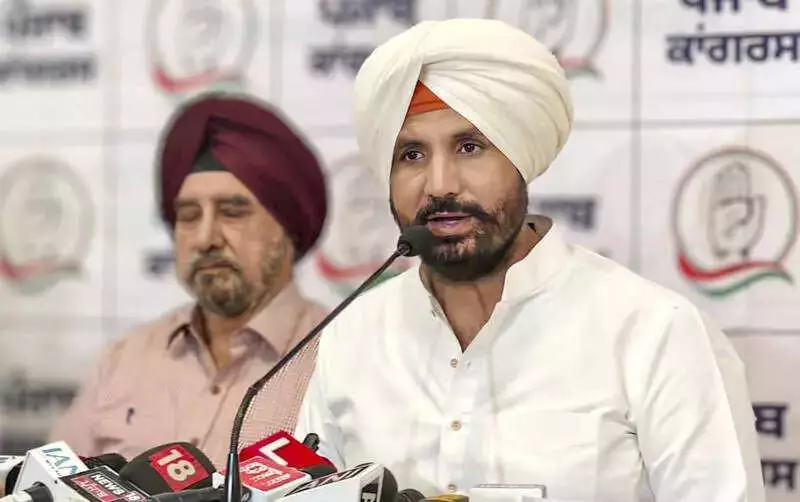
In a significant move aimed at bolstering electoral transparency, Punjab Pradesh Congress Committee (PPCC) president and Ludhiana Member of Parliament, Amrinder Singh Raja Warring, has approached the Punjab and Haryana High Court. The Congress leader filed a petition on Monday, seeking judicial directions to the State Election Commission to mandate the videography of vote counting for the recent Zila Parishad and Block Samiti elections.
Plea for Transparency in Democratic Process
Warring emphasized that the core of his petition revolves around the fundamental principle of free and fair elections. He stated that elections must be conducted in a manner that leaves no room for doubt or suspicion. "People have an inherent right to witness that every single vote is counted in a fair and just manner. Transparency is not just an option; it is the very soul of a functioning democracy," Warring asserted following the filing of his plea.
The petition argues that the counting of votes is a critical, inseparable, and decisive phase of the entire electoral exercise. This process continues right up until the final results are formally declared. Despite this established legal significance, Warring submitted that the counting for local body elections like those for Zila Parishads is currently conducted without any compulsory audio-visual recording.

Addressing the "Opaque" Counting Process
The Congress leader's petition highlights a crucial gap in the electoral framework. He contends that the absence of a mandatory videography mechanism results in no objective or verifiable record of what is arguably the most sensitive stage of any election. This lack, according to the plea, renders the entire counting process opaque and susceptible to arbitrariness or even allegations of manipulation.
Such a scenario, Warring argues, ultimately erodes public trust in democratic institutions. The petition further states that this opacity potentially violates several articles of the Constitution of India, which enshrine the principles of free and fair elections as part of the nation's basic constitutional structure.
A Preventive Safeguard, Not a Challenge
Importantly, Warring clarified that his legal action is not intended to challenge any specific election outcome or result that has already been declared. Instead, he frames it as a plea for preventive institutional safeguards. He advocates for mandatory videography as a minimal, reasonable, and constitutionally permissible measure to strengthen the process itself.
The petition points out that introducing videography would serve multiple constructive purposes without disrupting the electoral machinery. It would neither interfere with the actual process nor compromise the sacred secrecy of the ballot. On the contrary, Warring submitted that it would enhance accountability, act as a deterrent against potential malpractice, and significantly reduce the number of post-election disputes and litigations.
By moving the High Court, the Punjab Congress chief has initiated a legal conversation about modernizing and securing the electoral process at the grassroots level of governance. The outcome of this petition could set a precedent for how vote counting is conducted in local body elections across the region, aiming to fortify public confidence in India's democratic pillars.






