

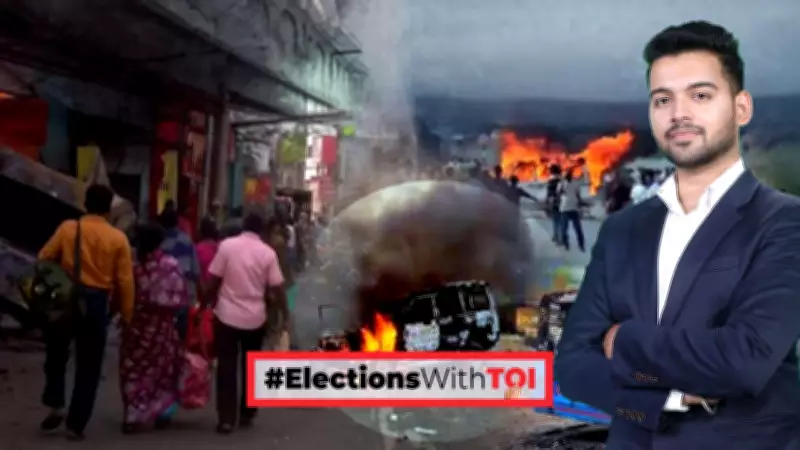
West Bengal has long been one of India's most sensitive states in terms of election-related violence. This report explains the structural and political reasons behind recurring poll clashes, including strong cadre-based mobilisation, intense local power struggles, and pre-poll triggers that escalate tensions before voting begins. It also highlights why districts like Murshidabad and Siliguri repeatedly emerge as hotspots, and how, despite phased polling and heavy security deployment, ground-level political competition continues to fuel violence across election cycles.
Root Causes of Recurring Clashes
The state's political landscape is dominated by highly organised party cadres, particularly from the Trinamool Congress (TMC) and the Bharatiya Janata Party (BJP). These cadres are deeply entrenched at the local level, often leading to confrontations over turf, voter intimidation, and retaliation. Additionally, local power struggles between rival factions, sometimes independent of national party lines, add another layer of conflict. Pre-poll triggers, such as provocative speeches, processions, or alleged attacks, can quickly escalate into widespread violence.
Hotspot Districts: Murshidabad and Siliguri
Murshidabad and Siliguri have consistently been flashpoints. In Murshidabad, communal tensions and strong local leadership often spark clashes. Siliguri, a strategic corridor, sees intense competition between TMC and BJP, with both parties accusing each other of instigating violence. Despite heavy security, the high stakes of winning these constituencies lead to aggressive campaigning and skirmishes.

Security Measures and Their Limitations
The Election Commission has deployed central forces and conducted phased polling to manage violence. However, ground-level political competition remains fierce. Allegations of attacks on candidates and workers, such as the reported incident involving BJP booth agent in Cooch Behar or the stone attack on BJP candidate Agnimitra Paul in Asansol, highlight the persistent tension. Both TMC and BJP trade accusations, but the underlying structural issues remain unaddressed.
Political Narratives and Violence
Prime Minister Narendra Modi's statement that 'TMC IS FINISHED' and Suvendu Adhikari's prediction of 'Parivartan Hoga' reflect the high-voltage rhetoric. Such narratives can mobilise supporters but also inflame passions. Meanwhile, TMC denies allegations of being anti-women, as raised by BJP, further polarising the electorate.
In conclusion, West Bengal's election violence is a complex phenomenon rooted in cadre culture, local rivalries, and political brinkmanship. Without addressing these deep-seated issues, clashes are likely to recur in future elections.






