

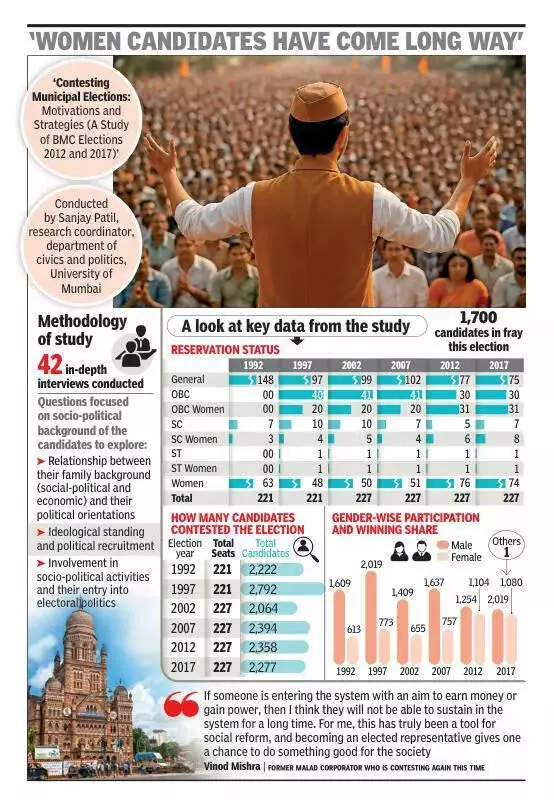
A revealing academic study from the University of Mumbai has dissected the driving forces behind why individuals choose to stand for elections in the country's wealthiest municipal body, the Brihanmumbai Municipal Corporation (BMC). The 158-page research, titled 'Contesting Municipal Elections: Motivations and Strategies (A Study of BMC Elections 2012 and 2017)', was published on the State Election Commission website and offers a deep dive into the political landscape of India's financial capital.
Six Primary Motivations for Contesting
Conducted by Sanjay Patil, research coordinator from the university's department of civics and politics, under the guidance of Professor Surendra Jondhale, the study began in February 2017 and was released in November of the same year. It identified six core factors that propel candidates into the electoral fray. These include political ambition, political legacy and patronage networks, pressure from supporters, the opposition's strength, perceived chances of winning, and the tangible benefits of holding office.
The report notes that these motivations frequently overlap. A significant attraction is the potential to advance business interests by gaining easier access to officials and speeding up bureaucratic clearances. The study also highlights the lure of financial gains, often connected to sectors like real estate, illegal construction, hawking networks, and civic contracts.

The Enduring Role of Dynastic Politics and Strategy
Dynastic politics remains a central feature, a pattern the study observed is still prevalent today with sitting MLAs seeking tickets for their relatives. Examples cited include Colaba MLA Rahul Narwekar and Malad MLA Aslam Shaikh, each with three family members contesting in the upcoming civic elections. Professor Jondhale explains this as a clear strategy for leaders to perpetuate their hold on power by fielding family members, such as wives or children.
The research also pointed out a tactical advantage related to electoral reservations. An OBC woman candidate is considered the most flexible partner for many aspiring corporators, as she can contest across General, OBC, Women, and OBC-Women categories.
Social Motivation and the Changing Face of Candidates
Beyond power and profit, the study found some candidates are socially motivated. Their goals include engaging directly in policy-making, proposing alternative governance models, or tackling corruption within the BMC. Others enter the race to champion specific local causes like slum redevelopment and housing issues.
Despite the study being around eight years old, researcher Sanjay Patil asserts that the core dynamics have not changed much. The role of informal and patronage networks in civic politics has only grown, continuing to shape political interests. He notes a shift where politicians have evolved from having nexuses with business interests to becoming political entrepreneurs themselves.
However, Patil highlights a positive change: women candidates have come a long way from being mere proxies. Exposure to the system has enabled many to assert their agency and become genuine stakeholders rather than just signatories. He also described strategic campaigning, like a former corporator having his doctor daughter spend time at a local clinic to connect with voters, which ultimately helped her secure a ticket.
A senior politician anonymously noted the visible change in an elected corporator's lifestyle, often marked by a shift to more expensive cars and a significant spike in declared assets between election affidavits.
However, not all agree with the study's observations. Advocate Tulip Miranda, a Congress nominee from Kalina, emphasized the joy of public service, while independent candidate Nehal Shah from Matunga, a former BJP corporator, stressed that the role is about impacting thousands of lives, not entitlement.






