Redefining 'Talent' in the World of Competitive Chess
In the lexicon of sports journalism, the word "talent" is ubiquitous yet often ambiguous. It is casually applied to athletes who capture public imagination early or exhibit aesthetically pleasing skills, such as cricket legend Sachin Tendulkar or tennis icon Roger Federer. However, two recently published books on chess converge on a more nuanced and critical perspective regarding this terminology.
The Insider's View: Anand's Critique of 'Talent'
In Lightning Kid: 64 Winning Lessons from the Boy Who Became Five-Time World Chess Champion, co-authored with Susan Ninan, Viswanathan Anand offers a revealing insight. "People call you talented when they don't see you as a real threat," Anand writes. Having been labeled a prodigy since his teenage years, Anand understands the subtle condescension often embedded in the term. He notes that despite his early achievements, the chess establishment initially viewed him as a mere "talent"—a player expected to shine briefly before fading away, rather than a genuine rival.
Echoing this sentiment, Binit Priyaranjan in The Price of Genius: Inside the World of India's Chess Prodigies elaborates: "Due to his unconventional style and the relative obscurity of his origins, he was still regarded as a 'talent' by the greats of the game—a polite term used for players expected to burn bright for a brief while before fizzling out—as opposed to a 'rival.'"

India's Chess Metamorphosis: From Obscurity to Powerhouse
The alignment of these viewpoints is unsurprising, given Anand's monumental influence on Indian chess. Today, the sport has undergone a dramatic transformation, establishing India as a global powerhouse that consistently produces young, "talented" players. Chess has evolved into a viable career path with financial sustainability, a theme both books address comprehensively.
Lightning Kid, tailored for young readers and adapted by Vatsala Kaul Banerjee, presents 64 concise lessons, each corresponding to a square on the chessboard. It intertwines Anand's life story with practical advice, such as: "Love your main passion, but don't make it the only thing in your life… Hobbies aren't a distraction—they refresh your mind… In the long run, this balance is your superpower." Another gem reads: "The best way to win is to understand how you lost."
The Prodigy Phenomenon: From Anand to Gukesh
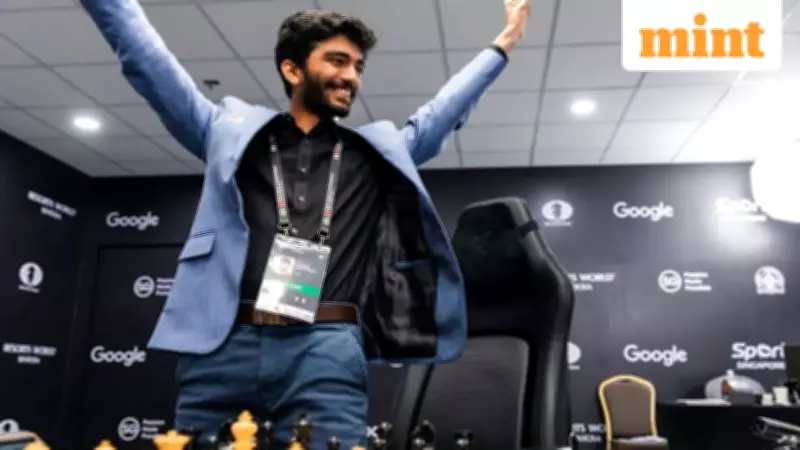
Anand's early ascent—becoming India's first Grandmaster at 18 in 1987—contrasts sharply with the current generation. In 2018, R Praggnanandhaa set a record as the youngest Indian GM at 12 years, 10 months, and 13 days, only to be surpassed a year later by D Gukesh at 12 years, 7 months, and 17 days, who later became world champion.
While Anand's journey to a five-time world champion is well-documented, Lightning Kid delves deeper into the cognitive processes of chess players. He demystifies the common assumption of photographic memory, explaining instead that players memorize patterns, structures, and tactical ideas. "Our minds chunk them together into meaningful units, the same way a musician doesn't remember every note individually but sees entire chords and phrases," Anand clarifies, emphasizing that memory is built through practice, patterns, and perspective.
Mentorship and the New Generation
In his semi-retirement, Anand has embraced mentorship through the Westbridge Anand Chess Academy (WACA), nurturing young talents like Nihal Sarin, Praggnanandhaa, R Vaishali, Raunak Sadhwani, and Gukesh. Priyaranjan's The Price of Genius focuses on the "Fab Four"—Gukesh, Praggnanandhaa, Sarin, and Arjun Erigaisi—exploring the transition from prodigy to genius. He distinguishes prodigies as children with potential, whereas geniuses realize that potential through sustained achievement.
Priyaranjan provides a broader narrative of Indian chess's recent boom, highlighting increased visibility, state support, private investment, and the democratizing effect of online streaming during the pandemic. India has produced 80 of its 87 Grandmasters in the 21st century, many from affluent backgrounds that allow them to prioritize chess over academics. The book quotes Raunak Sadhwani's father: "A child prodigy in chess does not get to be a child in his childhood," underscoring the sacrifices involved.

The Quest for Understanding and Mastery
The Price of Genius aims to illuminate the lives of India's teenage chess stars, who travel globally and command lucrative earnings. This phenomenon is rare in Indian sports, paralleled only by figures like Sachin Tendulkar. Yet, the book sometimes skims the surface of its subjects' inner worlds, offering more about the sport's ecosystem than individual psyches.
Together, these books provide an accessible introduction to chess in India. Anand reflects: "… this is a stage every player goes through—moving from chasing success to finding freedom in the game itself. Because the game is more than a game to me; it has been a game-change for life." Through their insights, Anand and Priyaranjan challenge superficial labels, revealing the disciplined artistry behind what is often glibly called "talent."