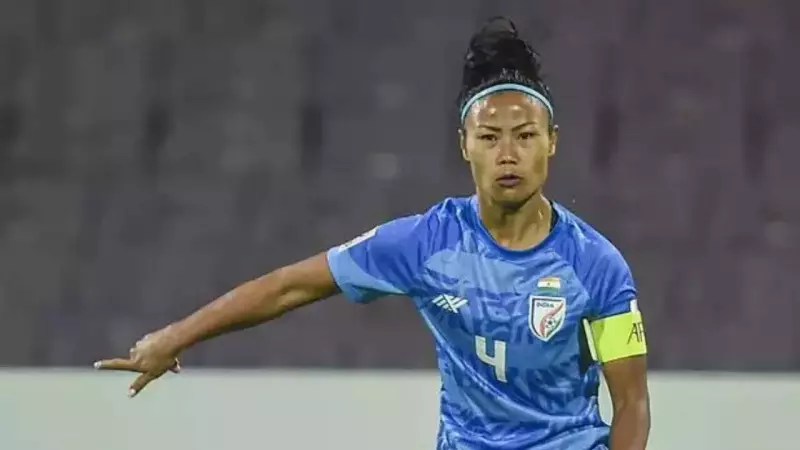
Indian women's football stalwart Ashalata Devi declares the dream of seeing the country compete at the FIFA Women's World Cup remains very much alive. She emphasizes that sustained progress at the grassroots level is absolutely crucial to bridge the gap with the world's elite footballing nations.
The World Cup Dream and a Defining Year Ahead
"Our dream of the World Cup is still alive. We still have to work even harder at this time," Ashalata told PTI in a recent interview.
The veteran defender, one of the most capped players in Indian women's football history, pointed to a significant opportunity. She noted that all three national teams—the Under-17, Under-19, and the senior side—have qualified for their respective AFC Asian Championships.

"Under-17, Under-19 and the senior team have already qualified for AFC competitions. If we do well there, obviously our dream of the World Cup is still alive," she explained. This makes 2026 a potentially defining year for the women's game in India.
Assessing Progress and the Path Forward
Ashalata, who has earned over 100 international caps and captained the national side on multiple occasions, offered a candid assessment. She acknowledged the team has made steady progress but remains short of world-class standards.
"We have been doing better for a long time, but still according to world-class levels, we are not there yet. Still, we are trying a lot," she stated.
Her faith in the current squad, however, is unwavering. "I have so much faith in the players. Their passion, hard work and dedication—they have been working for so many years. I really hope this time we qualify for the World Cup and do better for Indian women's football," Ashalata added with conviction.
The Critical Need for Grassroots Development
Having spent more than a decade anchoring India's defence, Ashalata identified grassroots development as the most urgent area needing attention. She believes a fundamental flaw exists in how young talent is nurtured.
"The problem is that we skip the basics and go straight to the technical aspects," she observed.
Drawing from her own journey, she highlighted the importance of starting young. "In my time, I started playing football at the age of 13. Now many players start at 10 or 11. But if we start at five or six years, learning becomes much better."
She stressed that skill acquisition becomes increasingly difficult with age. "After 17 or 18 years, teaching skills like ball control becomes very difficult. By then, players play more by expression than learning. That's why grassroots football is very important," Ashalata elaborated.
Call for Broader Responsibility Beyond AIFF
While acknowledging the vital role of the All India Football Federation (AIFF), the senior professional said responsibility must also lie with state associations.
"AIFF has a big role, but every state has its own association. They must show interest and take initiative. Everything cannot be done only at the top level," Ashalata asserted.
She added that consistency at the state level is essential to create a sustainable and reliable pipeline of talent for the national team.
Planning for the Future: The Ashalata Devi Football Festival
Off the field, Ashalata has already begun planning her contribution to the game beyond her playing career. She started the Ashalata Devi Football Festival (ADFF) in Imphal along with fellow India international Aditi Chauhan.
"I never knew what I would do after retirement other than football. I still feel connected to football and I wanted to do something for it," she shared.
Drawing from her personal struggles, the Festival aims to solve a common dilemma for young athletes. "When I was young, I couldn't manage football and school together because there was no academy near my house. I don't want the next generation to face what I struggled with," Ashalata explained.
The initiative focuses on combining football training with education. Its initial response has been overwhelmingly positive, exceeding Ashalata's expectations.

"I planned for around 50 players, but almost 47–48 kids came. I never expected such a response, and I'm really happy," she concluded, signaling hope for the future she is helping to build.