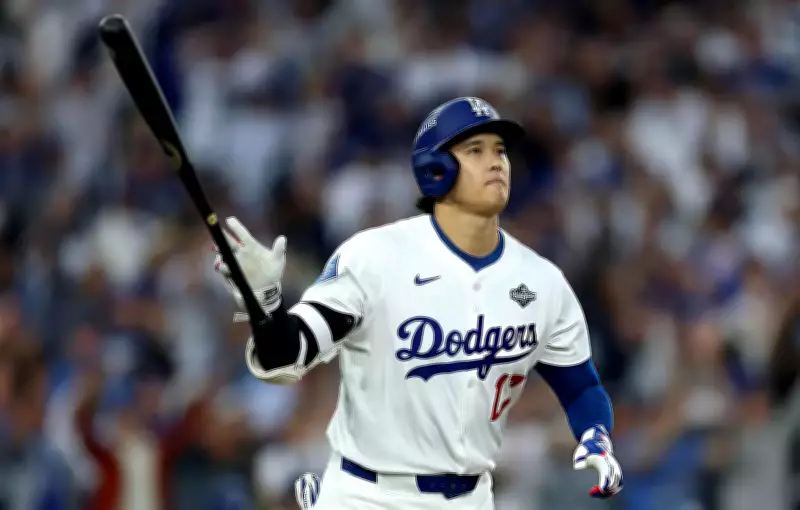
The Dodgers' Financial Dominance: A New Era in Baseball Economics
The Los Angeles Dodgers have transcended traditional baseball competition, operating in a financial stratosphere that is reshaping Major League Baseball's landscape. With a superstar roster featuring Shohei Ohtani, Mookie Betts, and Freddie Freeman, their on-field success has become almost predictable, culminating in another World Series championship where players admitted they didn't even perform at their peak. This isn't just about winning games—it's about how financial power can create an unprecedented competitive advantage.
Staggering Financial Numbers Behind the Success
According to FanGraphs projections, the Dodgers' 2026 payroll is set to reach a staggering $386 million. Even more revealing, Spotrac data shows their competitive balance tax payroll at $413.6 million—nearly $170 million above the $244 million luxury tax threshold. This places them $96 million ahead of any other MLB franchise in tax payroll, creating a financial gap that's impossible for most teams to bridge.
The team's financial strategy relies heavily on deferred payments, which lowers their immediate cash outlay to $249.3 million (seventh in MLB) while maintaining their spending power. In 2025 alone, they paid $169.4 million in luxury tax—more than 13 teams spent on their entire rosters. This massive investment allowed them to acquire key players like Teoscar Hernandez and Tommy Edman, strengthening a lineup that secured the 2025 World Series title despite what players described as suboptimal performance.

The Engine Behind the Spending Spree
Several factors enable this financial dominance. The Dodgers benefit from a robust farm system that develops talent internally, sophisticated analytics that identify undervalued players, and most importantly, an $8.35 billion media rights deal with Spectrum SportsNet LA that provides unprecedented revenue streams. This combination of baseball intelligence and financial firepower has created what many consider baseball's first true superteam in the modern era.
MLB Owners Push for Structural Change
With the next collective bargaining agreement negotiations approaching, the Dodgers have become the central case study in how spending power impacts competition. Formal discussions between owners and players are expected to begin early in the 2026 season, likely by May at the latest. Owners are particularly focused on addressing economic inequalities, with a salary cap emerging as their primary proposal to restore competitive balance.
The proposed system would likely include both a cap to limit maximum spending and a floor to ensure minimum investment from all teams. The Dodgers' recent acquisitions, including the signing of Kyle Tucker to join their already-stacked 2026 lineup, have intensified these discussions and made them more urgent.
The Stakes of the Coming Negotiations
Industry sources suggest that without an agreement, MLB could face a lockout in 2027, with owners reportedly in a stronger financial position to withstand lost games than during previous labor disputes. While many analysts consider a full salary cap unlikely given player union resistance, owners' frustration with big-spending teams like the Dodgers and New York Mets has made it a central bargaining point. If implemented, teams would likely receive multiple seasons to adjust their rosters to comply with new financial restrictions.
How a Salary Cap Could Reshape Baseball's Landscape
A potential salary cap around $300 million would force the Dodgers to fundamentally rethink their roster construction. They would need to rely more heavily on homegrown talent from their farm system and become more selective about supporting player acquisitions. The team has already begun preparing for this possibility, avoiding contracts longer than three years this offseason as they enter what could become a multiyear adjustment period.
Without unlimited financial flexibility, the Dodgers might transition from being a historically dominant force to a consistently competitive team that must navigate postseason unpredictability without their current spending advantage. Their analytics department and player development system would remain assets, but the margin for error would shrink considerably.

Dodgers president Stan Kasten remains optimistic about the team's future regardless of potential changes, stating confidently that the organization will "contend every year" even under a salary cap system. However, the broader implications for MLB are significant—a cap could redistribute talent more evenly across the league while potentially limiting the kind of superteam construction that has defined recent seasons.
As baseball approaches a potential inflection point in its economic structure, the Dodgers' financial dominance serves as both inspiration for what resources can achieve and a cautionary tale about competitive imbalance. The coming negotiations will determine whether MLB embraces greater financial parity or continues to allow market size and revenue streams to dictate competitive outcomes in America's pastime.