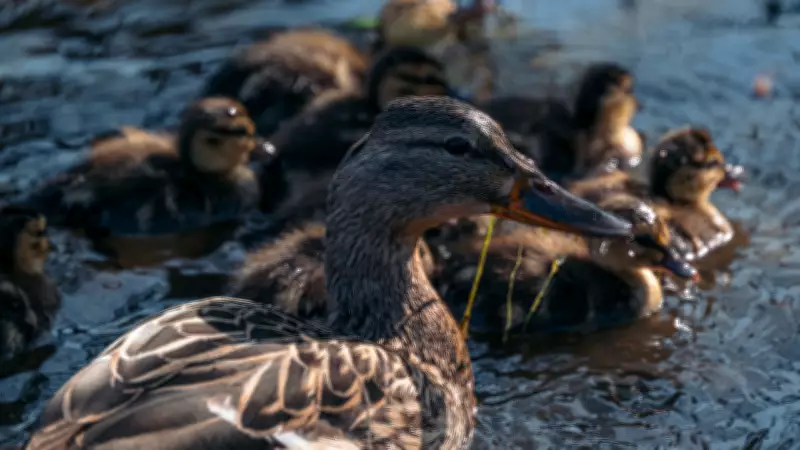
The image of a duck leading a long line of ducklings is often seen as a perfect family unit. However, in reality, these parades typically consist of ducklings from multiple broods. This phenomenon, known as brood amalgamation or crèching, is a highly developed survival strategy used by ducks and other water birds. It involves the merging of several broods under the supervision of one or two mother ducks, creating a large group that enhances survival chances, deters predators, and conserves energy.
Brood Amalgamation and Crèching Behaviour in Ducks
Brood amalgamation involves combining multiple broods of ducklings into a single group. This can occur voluntarily or when lost ducklings join an existing brood. According to the Canadian Journal of Zoology, mallard ducks often form mixed groups with ducklings from various mothers congregating under a single female. Studies on goldeneye ducks, such as 'Cooperation, Conflict, and Crèching Behaviour in Goldeneye Ducks,' indicate that this behaviour is common in areas with high predation rates. With more eyes, ducklings can detect and alert others to danger. Sometimes, an experienced female leads the group to food sources, bearing the burden but reaping the benefits of shared vigilance.
Predator Avoidance and Safety in Numbers
One key reason for forming large duckling parades is protection from predators like hawks, fish, and mammals. In a larger flock, the probability of any single duckling being taken is reduced—a concept known as the dilution effect. Additionally, the flock's collective motion confuses predators, making it harder to target individuals. Ecological studies by the Royal Society have explored this phenomenon.

Shared Parental Effort and Energy Efficiency
This system also allows adult ducks to share parenting duties. While one parent may seem overwhelmed, the group's collective awareness reduces stress. Sometimes, several females help guard the flock. This energy-saving approach is efficient in environments with scarce resources and high risks, as noted in bird behaviour studies.
What This Behaviour Reveals About Evolution and Adaptation
The emergence of crèching behaviour illustrates how natural selection shapes animal responses to environmental challenges. Ducks that adopted group strategies survived and passed on associated genes. Similar behaviour is seen in penguins, mammals, and fish, where grouping benefits all participants regardless of kinship. Understanding these strategies aids conservation efforts, especially in human-impacted habitats. While visually charming, giant duckling parades are a testament to nature's adaptive mechanisms, driven not just by maternal instinct but by survival imperatives.