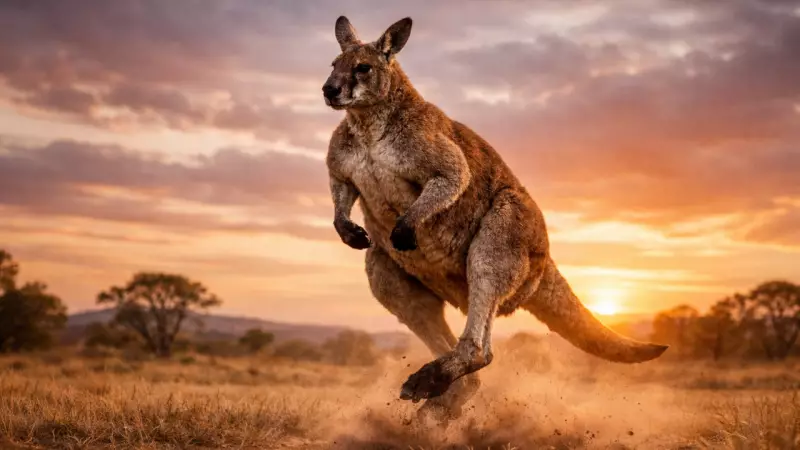
Fossil Evidence Challenges Assumptions About Giant Kangaroo Movement
For decades, paleontologists have grappled with a seemingly straightforward yet complex question: could Australia's extinct giant kangaroos hop like their modern counterparts? Contemporary kangaroos are marvels of biomechanical efficiency, utilizing powerful hind legs and spring-like tendons to traverse vast distances with minimal energy expenditure. However, when ancient species evolved to enormous proportions—some reaching weights of up to 250 kilograms—many researchers hypothesized that their massive bodies would have rendered hopping physically impossible.
A groundbreaking fossil-based study now presents compelling evidence that these heavyweight kangaroos may indeed have been capable of bipedal jumping, even if they did not employ this mode of locomotion as frequently or extensively as modern kangaroos do today.
New Research Brings Fresh Perspective to Longstanding Debate
The research, spearheaded by Dr. Megan Jones from the University of Manchester and published in the prestigious journal Scientific Reports, marks a significant departure from previous approaches. Rather than relying solely on comparisons with modern kangaroo anatomy, the investigative team meticulously examined fossils from extinct giant kangaroo species themselves. Their objective was to evaluate whether hopping remained mechanically feasible at such extreme body weights.

This question carries profound implications because hopping is far more than just a characteristic kangaroo behavior. It fundamentally influences how an animal evades predators, how far it can travel in search of food and water, and how it adapts to changing environmental landscapes. If giant kangaroos employed different modes of movement, it could dramatically reshape scientific understanding of their ecology and the factors that ultimately led to their extinction.
Why Size Was Initially Considered a Limiting Factor
Modern kangaroos achieve their remarkable hopping efficiency through a specialized anatomical feature: the Achilles tendon functions as an elastic spring. With each landing, this tendon stretches to store kinetic energy, which is then released to propel the animal into its next jump. This ingenious mechanism allows kangaroos to cover substantial distances without expending enormous amounts of metabolic energy.
However, as an animal's body mass increases, the mechanical stress placed on the tendon escalates exponentially. Without significant anatomical adaptations, a larger kangaroo would risk pushing the tendon beyond its safe operational limits, thereby increasing the likelihood of structural damage or catastrophic failure. This biomechanical constraint led many scientists to conclude that giant kangaroos were simply too heavy to hop at all.
Examining the Anatomy of Mega-Kangaroos
To directly test the hopping hypothesis, researchers analyzed fossils from multiple groups of extinct giant kangaroos, including:
- Sthenurines: Short-nosed browsing kangaroos that inhabited Australia between approximately 13 million and 30,000 years ago
- Protemnodon: Long-faced relatives of kangaroos that lived from about 5 million to 40,000 years ago
- Giant forms of Macropus: Oversized versions resembling contemporary kangaroos
One particularly notable species examined was Procoptodon goliah, believed to have weighed up to 250 kilograms—far surpassing the size of today's largest red kangaroos.
Bone Strength Emerges as Critical Factor
The research revealed that hopping capability depends not merely on tendon strength but equally on skeletal integrity. Successful hopping requires that the body's structural components can withstand repeated high-impact landings without fracturing.
The team specifically evaluated the strength of two key anatomical features:

- The Achilles tendon: Essential for storing and releasing energy during hopping
- The fourth metatarsal bone: A relatively vulnerable bone in the hindlimb that could easily fracture under excessive force
Their analysis indicated that the giant kangaroo species studied possessed bones robust enough to endure hopping stresses. Furthermore, their heel bone anatomy appeared capable of supporting a thickened tendon that could manage the substantial loads involved.
Thicker Tendons Do Not Necessarily Impede Hopping
Previous arguments had suggested that thickened tendons might compromise the spring-like efficiency required for effective hopping. However, the researchers counter that increased thickness does not automatically translate to reduced functionality.
They point to contemporary hopping animals, including kangaroo rats, which possess relatively thick tendons yet remain capable of effective hopping—particularly for rapid movement and predator evasion rather than extended-distance travel. This observation supports the possibility that giant kangaroos may have been physically capable of hopping, even if it wasn't their primary means of locomotion throughout the day.
A Nuanced Understanding of Prehistoric Locomotion
The researchers cautiously avoid overstating their conclusions. Their study demonstrates that hopping was feasible for giant kangaroos, not that these animals constantly bounded across the Australian landscape like modern red kangaroos.
Other gait patterns, including walking or striding, likely played significant roles in their movement repertoire. This is particularly plausible for sthenurine kangaroos, which other studies have suggested may have adopted a more upright, tiptoe-like posture during locomotion.
Implications for Understanding Ancient Kangaroo Ecology
Locomotion patterns fundamentally shape every aspect of an animal's existence—from feeding ranges and habitat utilization to survival strategies and reproductive behaviors. If giant kangaroos could hop, even occasionally, it suggests they may have been more mobile and adaptable than previously assumed.
This realization carries important consequences for comprehending their biological characteristics, their roles within prehistoric ecosystems, and the environmental pressures they confronted as Australia's climate and landscapes underwent dramatic transformations.
A 250-kilogram kangaroo might intuitively seem too heavy to hop, but fossil evidence now indicates these giants possessed both the tendon capacity and bone strength necessary for bipedal jumping. While they probably didn't hop over long distances like modern kangaroos, the capability existed and may have been employed when circumstances demanded it.
For the scientific community, this study provides a crucial piece in the complex puzzle of how these magnificent extinct animals lived, moved, and ultimately survived in Australia's ancient environments. It represents a significant step toward reconstructing the behavioral ecology of species that vanished thousands of years ago, yet continue to captivate our imagination today.