Injury-Plagued Hawks and Celtics Set for Pivotal NBA Clash on January 28, 2026
The highly anticipated NBA matchup between the Atlanta Hawks and Boston Celtics on January 28, 2026, promises to be a battle of resilience and adaptation rather than star power. Both franchises enter this contest significantly hampered by injuries, forcing coaches to rely heavily on rotations, strategic matchups, and players stepping into expanded roles. With neither team operating at full strength, this game will test depth and tactical execution more than individual brilliance.
Boston Celtics: Navigating Major Absences and Rotation Adjustments
The Boston Celtics approach this game with the superior record and a reputation for defensive stability, but they face substantial challenges. Jayson Tatum remains sidelined long-term following right Achilles repair surgery, a devastating blow that has reshaped the team's offensive identity. In his absence, Jaylen Brown has assumed the primary scoring mantle, while veterans Derrick White and Al Horford have taken on increased playmaking responsibilities.
Further compounding Boston's woes, Kristaps Porzingis is unavailable due to left Achilles tendinitis, and Josh Minott continues to recover from a left ankle sprain. The Celtics also face uncertainty with Payton Pritchard, who is questionable with left ankle soreness and will be a game-time decision.

With their rotation shortened, Boston has leaned heavily on:
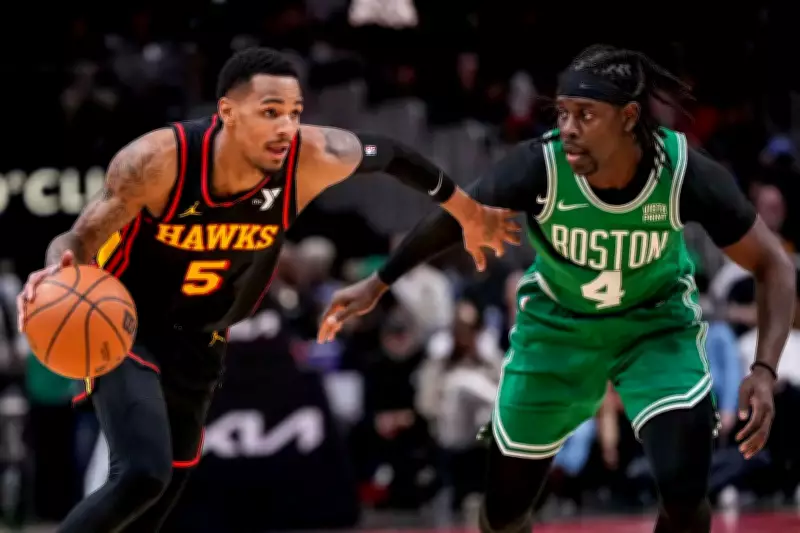
- Jrue Holiday for defensive leadership and ball-handling
- Sam Hauser for perimeter shooting and spacing
- Luke Kornet for interior presence and rim protection
These players have seen their minutes increase dramatically, particularly in lineups designed to maintain defensive integrity while creating offensive opportunities.
Atlanta Hawks: Battling Depth Issues and Key Injuries
The Atlanta Hawks find themselves in a similarly precarious position, with their injury list reading like a medical report. Like Boston, they are without Kristaps Porzingis due to his Achilles issue, while promising forward Zaccharie Risacher is sidelined with a left knee bone contusion. The Hawks have suffered a devastating blow with rookie center N'Faly Dante ruled out for the season following a right ACL tear.
Atlanta's backcourt faces uncertainty as well, with Dyson Daniels listed as questionable due to a right ankle sprain. His potential availability could provide crucial defensive stability and playmaking support. With limited options, the Hawks will likely depend on:
- Trae Young to shoulder immense offensive responsibility
- Onyeka Okongwu to control the paint and provide energy
- Jalen Johnson (if active) to contribute across multiple statistical categories
These players are expected to log heavy minutes as Atlanta fights to maintain competitiveness in the Eastern Conference standings.
Historical Context and Statistical Overview
The historical record between these franchises heavily favors Boston, with the Celtics holding a commanding 246-151 advantage across 397 regular-season meetings. This dominance has continued in recent encounters, with Boston securing victories in four of the last five matchups against Atlanta. This January 28 contest likely represents the second or third meeting between the teams this season, with Boston having already claimed at least one earlier victory.
A statistical snapshot of the 2025-26 season reveals contrasting team profiles:
Boston Celtics (approximately 29-17 record) boast a top-10 offensive rating and elite top-5 defensive rating, resulting in a clearly positive net rating. They score around 116-117 points per game while allowing only 110-112 points, demonstrating their balanced approach.
Atlanta Hawks (approximately 20-23 record) maintain a slightly higher scoring average of 117-118 points per game but struggle defensively, allowing 115-116 points. Their offensive rating ranks around 19th in the league, while their defensive rating sits near 16th, resulting in a slightly negative net rating.

Key Factors and Strategic Considerations
This injury-marred contest presents distinct strategic challenges for both teams. Boston will likely attempt to control tempo, slowing the game to leverage their defensive strengths while relying on Jaylen Brown and Derrick White to generate half-court offense. Their approach will emphasize disciplined execution and minimizing transition opportunities for Atlanta.
Conversely, Atlanta needs to establish pace and energy, pushing the ball in transition to create easier scoring opportunities. Rebounding dominance and a spectacular performance from Trae Young appear essential for the Hawks to remain competitive. With both teams missing key contributors, this game may ultimately be decided by:
- The effectiveness of role players in expanded minutes
- Bench contributions and unexpected performances
- Late-game execution and decision-making under pressure
This January 28, 2026 showdown represents more than just another regular-season game—it's a test of organizational depth, coaching adaptability, and player resilience for two Eastern Conference contenders navigating challenging circumstances.