India's Chess Gender Equality Ranking Drops, Exposing Deep-Rooted Challenges
Last Sunday, as International Women's Day flooded social media with celebratory posts, a sobering report emerged from the chess world. The FIDE Women in Chess Commission (WOM) and the University of Queensland released the 2026 Gender Equality in Chess Index (GECI), revealing that India has slipped one place to 25th in the global rankings since the inaugural 2023 edition.
Understanding the Gender Equality in Chess Index
The Gender Equality in Chess Index is a comprehensive tool developed by FIDE, the international chess governing body, to quantify gender balance across national federations worldwide. Grandmaster David Smerdon, associate professor at the University of Queensland and lead author of the report, emphasized its purpose: "When we created the GECI in 2023, we aimed to provide federations with a clear, evidence-based snapshot of their gender equality status. Improvement hinges on measurement."
The index leverages FIDE's global ratings database and youth championship participation records to compute a composite score based on three critical pillars: Participation, which measures the share of women among active rated players; Performance, assessing the strength gap between men and women via average Elo ratings; and Progress, tracking the proportion of girls in international youth championships.

India's Performance: A Tale of Two Realities
In the 2026 GECI report, India's overall score stands at 71.04, resulting in the drop to 25th place. However, a closer look at the data unveils a stark contrast. India excels in Performance with a staggering score of 97.49, up from 88.31 in 2023, indicating that elite female players are world-class. Yet, Participation lags at a meager 18.72, and Progress declined slightly to 49.09.
This disparity highlights a significant structural imbalance: while India produces top-rated female chess stars, the broader ecosystem struggles to attract and retain girls at the grassroots level. Globally, female participation in chess remains low, with only 238,716 women out of 1,446,605 active players, representing just 16.5%.
Root Causes of the Gender Gap in Indian Chess
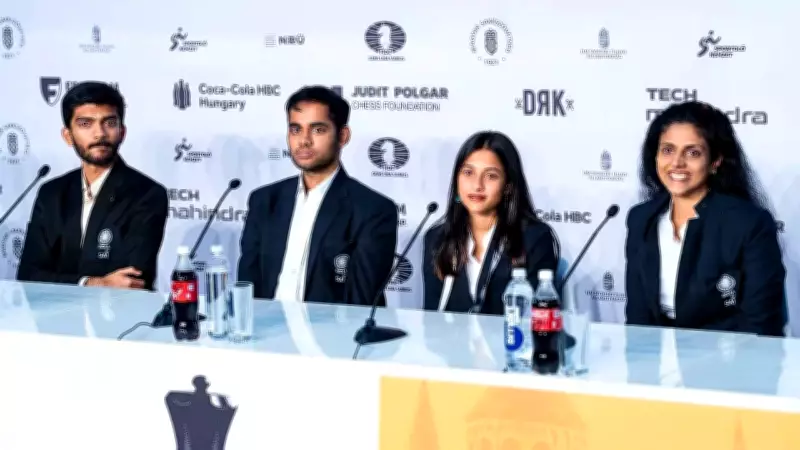
The challenges begin early, as societal expectations often limit girls' ambitions. Grandmaster Harika Dronavalli noted, "Girls are not encouraged to pursue ambitious goals in the same way boys are. Talent exists, but societal norms frequently curtail their potential." Coach Grandmaster Srinath Narayanan observed that many promising girls abandon chess between ages 13 and 15 due to pressures to prioritize academics or domestic responsibilities.
International Master Vantika Agrawal pointed to financial and competitive barriers: "Competing internationally is costly, and female players lack opportunities to face stronger opponents, hindering their growth. In a male-dominated society, women do not receive equal support." This often forces young girls into women-only events, limiting exposure to tougher competition crucial for development.
Systemic Issues and the Need for Institutional Support
Grandmaster Pravin Thipsay highlighted the individualism prevalent in Indian chess: "There is no systemic framework to produce champions; success relies on parental and player efforts. Unlike the Soviet or Chinese models with continuous talent pipelines, India depends on individual sacrifices." He stressed that without intervention from the All India Chess Federation (AICF), growth may remain confined to certain regions.
Pathways to Improvement and Lessons from the UAE
The GECI framework suggests actionable solutions: increase female participation at grassroots levels, encourage girls to compete in open events for stronger exposure, and provide financial backing through travel grants and sponsorships. The United Arab Emirates offers a compelling blueprint, having surged from 77th to 4th place by boosting female participation in youth delegations from 12.5% to 43.75%.
The UAE institutionalized female chess with dedicated clubs, mandatory female representation in governance, and a year-round competitive calendar. Dr. Maliha Mahmoud Al Mazmi, Secretary-General, exemplifies leadership inclusion. By supporting families and embedding women in key roles, the UAE created a sustainable professional pipeline.

Conclusion: Building a Sustainable Future for Indian Chess
India possesses immense talent, as evidenced by its high Performance score. However, to ascend in the GECI rankings and foster gender equality, a systemic approach is essential. By adopting targeted policies, enhancing grassroots engagement, and ensuring financial and competitive support, India can transform its chess landscape. The data underscores that with strategic intervention, the nation can harness its potential and create a robust model for female chess development.