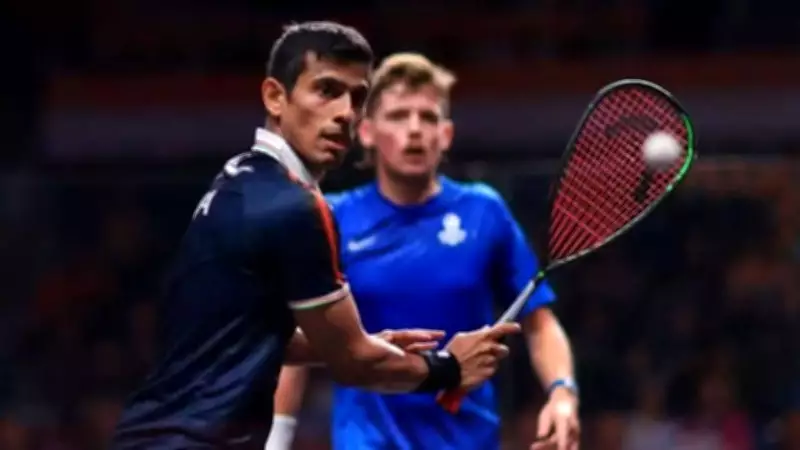
India's Olympic Squash Dream Hinges on Precise Timing and Peak Performance
The dream of seeing Indian squash players compete at the Olympic Games remains vividly alive for Los Angeles 2028, but as veteran star Saurav Ghosal emphasizes, the qualification pathway is exceptionally narrow and unforgiving. With squash making its historic Olympic debut at the 2028 Summer Games, the field will be tightly restricted to just 16 players per gender, creating a scenario where even world-class competitiveness may not suffice.
A Qualification System That Leaves Little Room for Error
Ghosal, who has meticulously analyzed the official qualification framework, points out that the structure itself is designed to be highly selective. Under the current rules, eight players will earn direct entry through their world rankings, with a strict maximum of two athletes per nation allowed. "Assuming dominant nations like Egypt and Great Britain on the men's side, and Egypt and the United States on the women's, that immediately accounts for four of those eight ranking spots," Ghosal explained. "The remaining four positions then go to the next-best-ranked players from different countries."
This mathematical reality, at least based on current standings, does not favor Indian men's squash. According to the latest Professional Squash Association circuit rankings, countries including Egypt, Great Britain, Peru, New Zealand, Mexico, and France occupy the top eight eligible slots. "Prima facie, if the qualification deadline were today, we would not make it on the men's side purely based on rankings," Ghosal stated candidly. "This makes the Asian Games our most viable alternative pathway."

The Asian Games: A Brutally Demanding Gateway
However, the Asian Games route presents its own monumental challenge. Only the individual gold medalist secures a guaranteed Olympic berth, turning the continental event into a high-stakes, winner-takes-all scenario. "Winning the Asian Games is an extraordinarily difficult task," Ghosal admitted, drawing from his own extensive experience. "I have not won an individual gold myself. While medaling is an achievement, here you must win the entire tournament."
India's current highest-ranked male player, Abhay Singh, sits at world number 29, placing him outside the automatic qualification zone. This positioning means that for the men's team, the Asian Games or a dramatic late surge up the rankings represent the most realistic hopes. Ghosal also mentioned a final qualification tournament open to players from nations not already represented, but described it as "last-chance saloon territory."
Anahat Singh: India's Brightest Hope on the Women's Side
India's most promising prospect appears on the women's side, where teenage sensation Anahat Singh is already making significant strides. Ranked 19th in the world, she is within striking distance of the top-tier qualification spots. "With Anahat, being ranked 19, she might be close," Ghosal noted. "She's within touching distance, but it will undoubtedly be touch and go."
The competition remains intensely fierce, with players from Malaysia, Japan, and Belgium all hovering in similar ranking brackets. This makes consistent performance over the next two years absolutely critical for Singh's Olympic aspirations. "We are still approximately two years away from the qualification cutoff in May 2028," Ghosal highlighted. "Ideally, she continues to climb the rankings so that we do not have to rely on the Asian Games as a fallback option."
The Inherent Challenge of a Limited Olympic Field
Ghosal stressed that the difficulty was inherent from the moment the International Olympic Committee decided to cap the squash field at 16 athletes per gender. "It was never going to be an easy process," he said. "The IOC clearly aims for a balance between a strong competitive field and broad global representation. This is why the qualification system incorporates world rankings, Continental Games results, host nation quotas, and a final qualification tournament."

In practical terms, this multifaceted system means that Indian players must peak at precisely the right moments. Whether through a steady ascent in the world rankings or a flawless, gold-medal-winning performance at the Asian Games, timing is everything. "It ultimately comes down to one perfect week," Ghosal concluded. "If everything aligns during that critical period, anything is possible. But in this scenario, it is not about securing a bronze medal. You must win."