Kangaroo Chaos Erupts at Tour Down Under Cycling Race in Australia
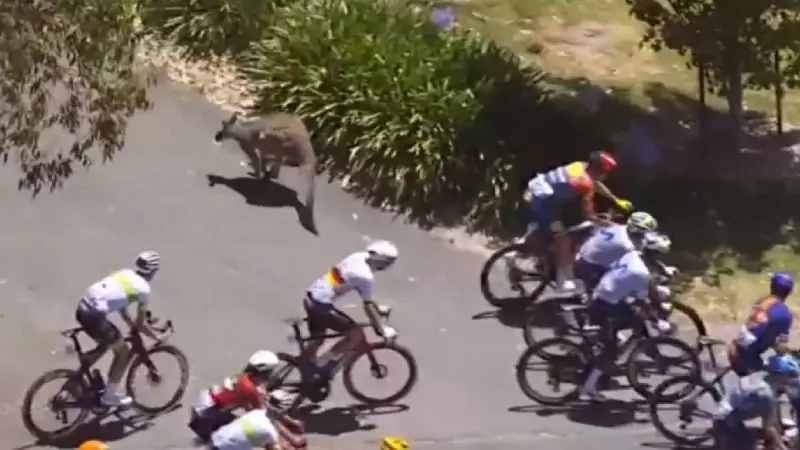
In a bizarre and dramatic incident that could only happen in Australia, two kangaroos waded hoppingly into the path of the professional cycling peloton during the Tour Down Under, causing a high-speed collision with race leader Jay Vine. The chaotic scene unfolded in the Adelaide Hills, where cyclists were speeding at approximately 50 kilometers per hour, turning a routine race into a nightmare scenario for competitors.
High-Speed Impact and Immediate Aftermath
The collision occurred with about 96 kilometers remaining in the 169.8-kilometer stage, as the kangaroos unexpectedly bounded onto the road during a sprinting section. Jay Vine, the overall race leader, struck one of the animals and was violently knocked from his bike. Despite the shocking impact, Vine demonstrated remarkable resilience by quickly getting up and switching bikes with teammates to continue the race.
Vine later described the incident to WDEF.com, explaining how the kangaroos "blasted through the peloton" as cyclists maintained speeds around 50 kph. He recounted how one kangaroo stopped and moved erratically—"left, right, left right"—before he ultimately collided with its backside. The Australian champion, who went on to win his home race for the second time in three years, has long considered kangaroos the most dangerous hazard in Australian cycling.

Casualties and Consequences
The collision had significant consequences for both animals and riders. One kangaroo sustained serious injuries and had to be euthanized following the incident, while the second marsupial managed to escape apparently unharmed. On the human side, three cyclists—Menno Huising, Lucas Stevenson, and Alberto Dainese—were forced to abandon the race due to the crash.
Video footage of the incident shared by SBS Sport showed Vine and other cyclists sprawled on the ground as one kangaroo attempted to hop across the road, navigating through the chaotic scene. Netizens quickly dubbed it "the most Australian crash ever seen," highlighting the uniquely Australian nature of the wildlife interference.
Race Context and Vine's Triumph Against Odds
The incident occurred during the UCI World Tour season opener, adding extra drama to an already challenging race for Vine and his UAE Team Emirates. Entering the final stage with a lead of 1 minute and 3 seconds on general classification, Vine had already seen two teammates crash out in previous stages, including defending champion Jhonatan Narvaez. With only two teammates remaining for the final stage, the kangaroo collision presented yet another obstacle.
Remarkably, Vine managed to rejoin the peloton with about 92 kilometers remaining after changing bikes twice. He maintained his lead throughout the remainder of the stage, ultimately finishing 1 minute and 3 seconds ahead of Swiss rider Mauro Schmid, with Australian Harry Sweeny a further nine seconds behind in third place.
Broader Implications and Reactions
The incident highlights the unique challenges of organizing cycling events in regions with abundant wildlife. Just the previous week, organizers of the Pune Grand Tour in India had expressed concerns about potential interference from dogs or cows, which could result in docking of organization points by cycling's world governing body. The Australian incident demonstrates that such wildlife hazards are not merely theoretical concerns.
Matthew Brennan of Britain, who won the stage in a sprint finish, acknowledged the disruption caused by the kangaroo collision, noting that teammate Menno Huising—who typically coordinates lead-out efforts for sprints—had been "smacked on by a kangaroo."
Vine reflected on the series of misfortunes that plagued his team throughout the race, stating, "This year we started off really positive and we just had more and more bad luck as the race went on." He added, "Today was never going to be easy and I've been saying all week it's not over until it's over. But it's proven to be not over till it's over in this race for us."
The tragic outcome for the kangaroo serves as a sobering reminder of the unpredictable nature of outdoor sporting events and the sometimes fatal consequences when human athletic endeavors intersect with wildlife habitats.