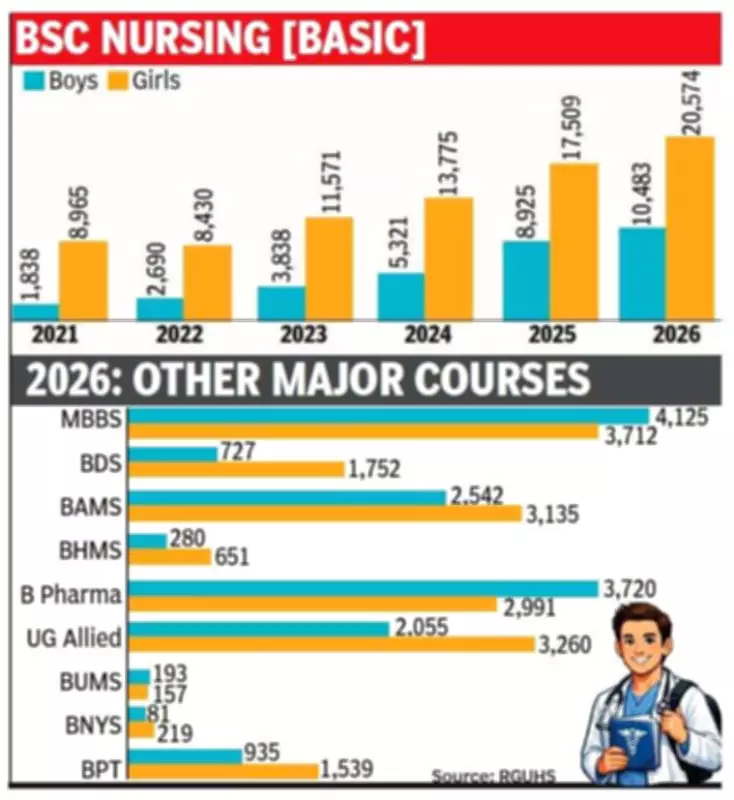
Bengaluru: In a significant shift within a traditionally female-dominated field, male students now account for 33% of BSc Nursing graduates at Rajiv Gandhi University of Health Sciences (RGUHS). At the recent convocation, over 10,000 of the 31,057 graduating students were men, marking a 450% increase from 1,838 male graduates out of 10,804 in 2021.
Gender Trends Across Health Courses
Among all health students graduating in 2026, only MBBS and B Pharm had male majorities. In MBBS, the gender gap fluctuated: boys led by 581 in 2022, narrowing to 198 in 2023, peaking at 774 in 2025, and settling at 4,125 boys versus 3,712 girls in 2026. In pharmacy, 3,720 boys graduated compared to 2,991 girls. Conversely, Bachelor of Dental Surgery (BDS) remained female-dominated, with 727 boys and 1,752 girls.
Drivers of Male Nursing Influx
Dr. Bhagvan BC, RGUHS vice-chancellor, attributed the trend to strong demand and job security: “Nursing and allied health courses offer immediate employment. Japan, Australia, and European countries like Germany seek nurses. While other jobs face saturation, healthcare is growing.”

S Shivakumar, president of the Karnataka State Association of Managements of Nursing and Allied Health Sciences Institutions, added: “Male nurses are preferred in airports, industries, ambulance services, and night shifts. Hospitals must maintain gender ratios. Graduates quickly gain experience and move abroad for enviable pay.” He noted a strong influx from Kerala, where many have family members in nursing, and Karnataka’s low government seat fees also attract students.
Ali Khwaja, founder of Banjara Academy, said nursing is less competitive than NEET-focused courses. “Average students find nursing easier to enter. Male nurses are physically preferred for lifting patients. Once abroad, they rarely return.”