The Transformative Power of Golf's Greatest Rivalry
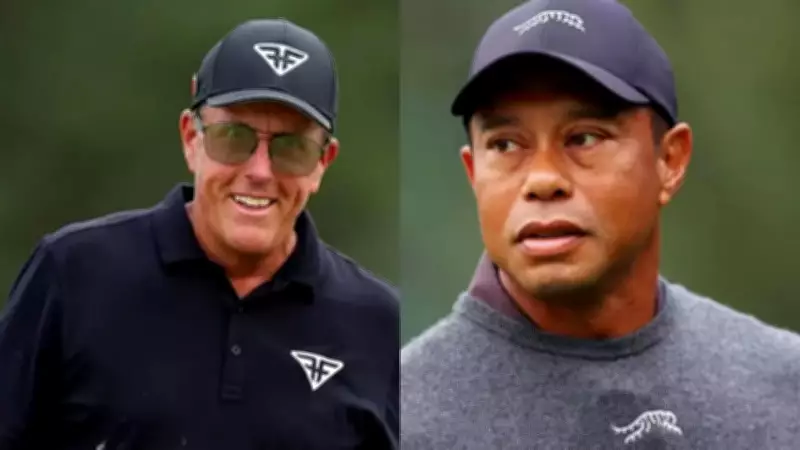
The legendary rivalry between Tiger Woods and Phil Mickelson has captivated the golf world for decades, often framed as a fierce battle for supremacy. However, beyond the headlines and tournament showdowns lies a profoundly positive narrative—one where competition served as the ultimate catalyst for greatness. Former LIV golfer Pat Perez recently shed light on how Woods not only outplayed Mickelson but fundamentally transformed him into the Hall of Famer we recognize today.
The Intimidation Factor That Reshaped a Career
On February 5th, during an appearance on the Golf Subpar Podcast, Perez emphasized the unparalleled intimidation Woods projected. "The intimidation factor that Tiger had is like nothing; you know, you might not see it again," Perez stated. He elaborated that this pressure directly elevated Mickelson's game, noting, "As great as Phil is, Tiger pushed him right here. He’s got 46 wins, six majors, and won one at 50." This insight underscores how Woods' presence forced Mickelson to evolve, leading to remarkable achievements late in his career.
By the Numbers: A Statistical Duel
Together, Woods and Mickelson boast an astounding 21 major titles and 127 PGA Tour victories. Mickelson's historic 2021 PGA Championship win at 50 years, 11 months, and 7 days made him the oldest major winner ever, a testament to his longevity. In their head-to-head matchups on the PGA Tour, the statistics reveal a closely contested rivalry: Woods shot a lower round 19 times, Mickelson 15 times, and they tied on 4 occasions. Early pairings often saw Woods edge out Mickelson by slim margins, such as 71 to 73, 68 to 75, and 72 to 71, highlighting the competitive tension that defined their encounters.

Mickelson's Strategic Response to Woods' Dominance
In 2007, Mickelson made a pivotal decision to recruit Butch Harmon, Woods' former swing coach, marking a turning point in his career. He overhauled his fitness regimen and honed his short game, efforts that paid immediate dividends with a victory at the Players Championship that spring. The moniker "Tiger Slayer" emerged in 2012 when Mickelson shot a stunning 64 to Woods' 75 at the AT&T Pebble Beach Pro-Am, securing an 11-stroke victory. This was no fluke but the culmination of years dedicated to matching Woods' intensity and skill.
Reflecting on this transformation, Mickelson acknowledged in 2015, "He owned me head-to-head until ’07. Over the course of my career, I believe that he pushed me to achieve a higher level of play." This statement goes beyond mere respect, recognizing how Woods' rivalry sculpted Mickelson's entire professional trajectory.
Longevity and Legacy: Woods' Enduring Impact
At the 2017 PGA Championship, Mickelson elaborated on the broader influence Woods had on the sport. "He forced everybody to work a little bit harder. He forced everybody to look at fitness as a big part of the game of golf, and I think that’s actually helped me with longevity," he stated. "I don’t think I would have had the same level of success had he not come around." Woods even inspired Mickelson to swing harder, contributing to his sustained performance. This sentiment is echoed by other golfers like Ernie Els, who faced Woods in multiple major finals, affirming that Woods' competitive drive elevated the entire field.
In essence, the Woods-Mickelson rivalry transcends individual victories and losses. It stands as a powerful example of how elite competition can forge greatness, pushing athletes to refine their skills, embrace fitness, and achieve milestones that redefine their legacies. As golf continues to evolve, this dynamic serves as an enduring lesson in the inspirational power of rivalry.