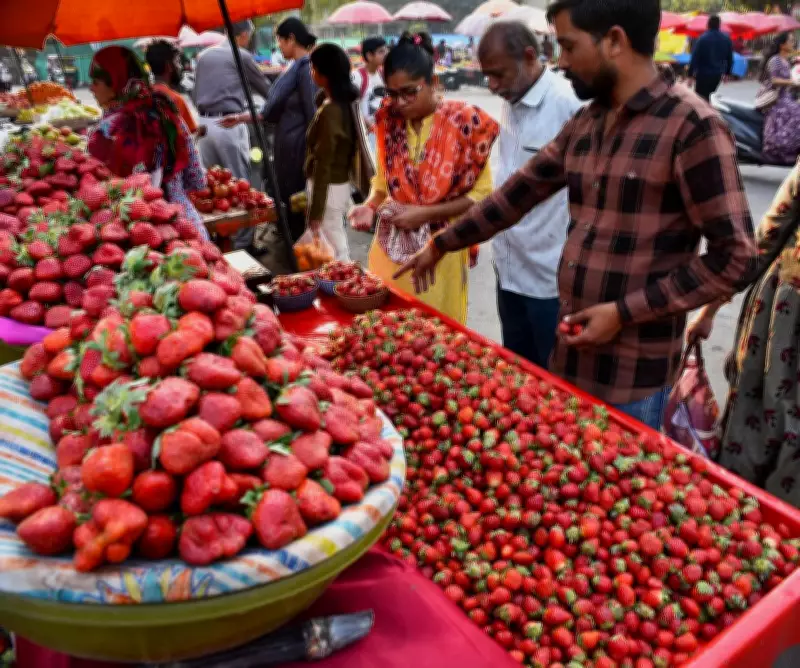
Gandhinagar: South Gujarat's Dang district, the first in the state to completely shift to natural farming, has emerged as a leading strawberry-producing region. The state government announced on Wednesday that farmers have reported annual earnings of up to Rs 8 lakh per hectare by cultivating nine varieties of strawberries.
Significant Growth in Cultivation Area and Production
According to official data, the area under strawberry cultivation in the district increased by 65%, from 20 hectares in 2022-23 to around 33 hectares in 2025-26. Production, which stood at 140 metric tonnes in 2022-23, rose to 196 metric tonnes in 2024-25 and is projected to reach 233 metric tonnes during 2025-26.
Factors Driving the Growth
The state government attributed the growth to favorable climatic conditions, increasing market demand, and the adoption of natural farming practices in the tribal district. Strawberries are well-suited to the district's cool climate and sandy, loamy soil rich in organic matter. The crop requires well-drained soil with a pH level between 5.5 and 7.0, along with 8 to 12 hours of sunlight for flowering and fruiting. Ideal temperatures for cultivation range from 22°C to 25°C during the day and 7°C to 13°C at night.

Strawberry Varieties Cultivated
Farmers in the district are cultivating nine strawberry varieties, including Winter Dawn, Early Winter, Camarosa, Sweet Charlie, Nabila, Nabadi, Selva, Belrubi, and Pajero. Among these, Winter Dawn has emerged as the most preferred variety due to its strong yield between December and February-March.
Villages Involved in Strawberry Farming
Farmers from several villages in Ahwa taluka, including Bhurapani, Borigavtha, Galkund, Kotamdar, Malegaon, Dabhas, Sonuniya, and Vanar, have taken up strawberry cultivation. Additionally, farmers from Kanchanpada, Ghodvahal, Murambi, and nearby villages of Waghai taluka have also adopted strawberry farming over the past few years.
Government Support
Farmers have been receiving subsidies ranging from 55 to 75 percent on strawberry saplings and cultivation-related expenses, further encouraging the shift to strawberry farming.