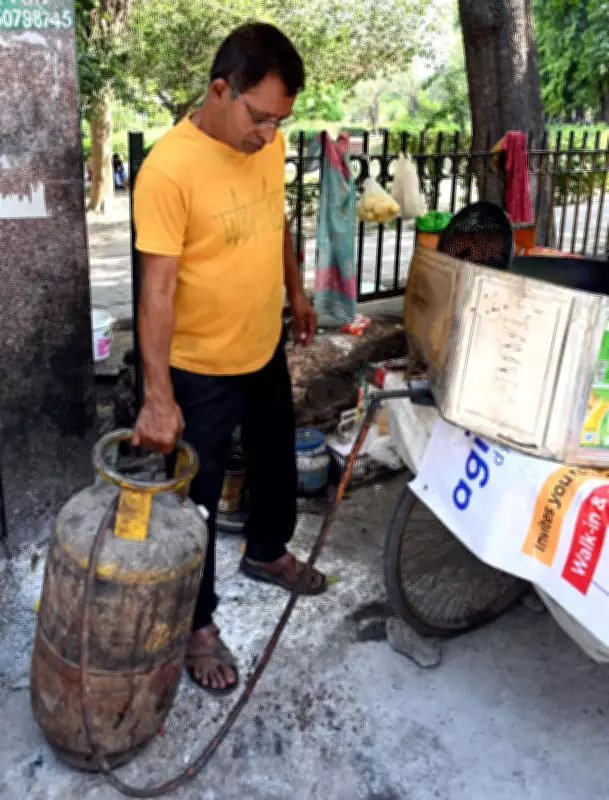
A significant increase in commercial LPG cylinder prices is making dining out and ordering in more expensive, affecting restaurants, street vendors, and large-scale food operations across Gurgaon and Noida. Industry representatives warn that while many are currently absorbing the higher costs, they may soon be forced to pass them on to consumers.
Rising operational costs
The price hike has raised operating expenses across the board. Combined with recent increases in minimum wages, profit margins are shrinking. Many restaurateurs are holding off on menu revisions and exploring alternatives for now.
Joy Singh, owner of Raasta Cafe and secretary of the National Restaurant Association of India (NRAI), said, “We will explore electric induction and piped gas connections to mitigate the impact. We don’t want to pass on the cost to the customer as of now.” He also highlighted that the availability of commercial LPG cylinders remains a persistent problem.

Varun Khera, president of NRAI’s Noida chapter, echoed a cautious approach: “The price of commercial LPG cylinders has been fluctuating for a while, with one of the most significant hikes seen now. We are not in a position to change menu prices yet — we want to see how far this goes.” He added that reprinting menus adds costs, and establishments are currently absorbing the hikes as losses. “The price hike is hurting our pockets. We are running our establishments out of our own pockets right now,” he said.
However, some are less optimistic about how long this can continue. One restaurant owner noted, “Margins are shrinking, and if the situation continues, passing costs to consumers will be unavoidable.”
Impact on industrial-scale food operations
Large-scale food providers are already revising prices. PK Gupta, chairman of PFTI, which supplies around 30,000 corporate meals daily, said fuel accounts for 10% of input costs. “Commercial LPG was first raised by Rs 400 in March and now by Rs 993,” he said, adding that supply constraints compound the pressure. “We are not getting the required number of cylinders.” Haryana’s recent minimum wage hike has added another layer of cost.
Street vendors hit hardest
Street vendors, with the least capacity to absorb shocks, have already raised prices and may do so again. Mani, who runs a small restaurant in Sector 14, said, “It is becoming difficult to operate under the current situation.”
The 5kg portable cylinders, used largely by migrants without domestic connections, have also risen by Rs 261 to around Rs 810, as they are priced on par with commercial cylinders.
Industry calls for government action
In March, NRAI wrote to Union Petroleum Minister Hardeep Singh Puri, urging the government to ensure adequate supply of commercial LPG cylinders to restaurants. The association noted that the supply situation had not improved and warned that the fresh hike would put additional pressure on the food services sector.
Deepak Maini of PFTI said, “At a time when businesses are struggling, governments in Haryana and UP have raised minimum wages, and now there’s another increase in commercial LPG prices. Instead of supporting an industry that generates employment and revenue, more obstacles are being created.”
Supply chain vulnerabilities
India imports nearly 60% of its LPG, with much of it routed through the Strait of Hormuz. The recent closure of this critical passage amid the US-Israel-Iran conflict has reduced supplies from key partners, including Saudi Arabia and the United Arab Emirates.