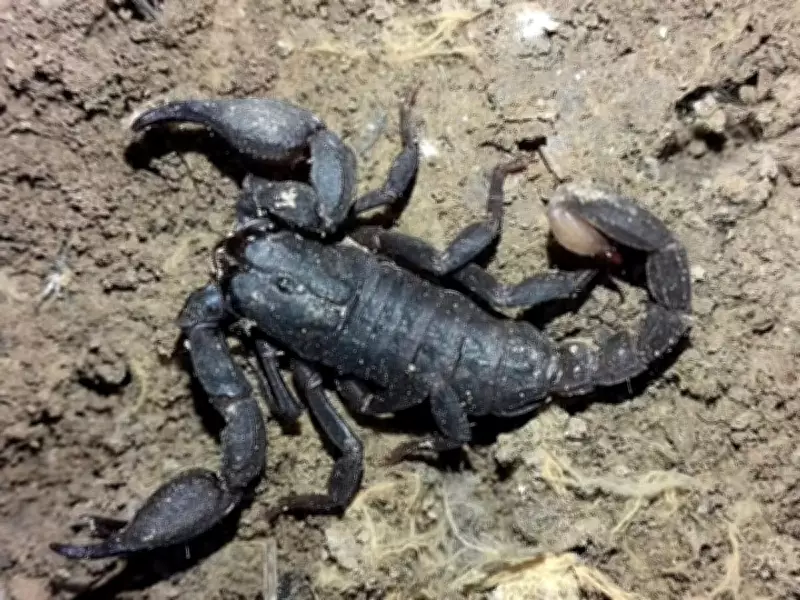
Scorpions are often judged solely by their venom, but new research reveals a hidden layer of sophistication in their anatomy. These arachnids, known for their curved tails and stingers, have evolved to incorporate metals into their exoskeletons, enhancing the strength and functionality of their claws and stingers. A study published in the Journal of the Royal Society Interface has shed light on how scorpions use metals such as zinc, iron, manganese, and calcium to fortify specific body parts, turning them into natural weapons.
Metal Enrichment in Scorpion Exoskeletons
The exoskeleton of a scorpion is primarily composed of chitin, a strong yet elastic compound found in arthropods. In high-stress areas, chitin becomes more sophisticated through the incorporation of metals. These fortified structures, known as heavy-element biomaterials, exhibit ceramic-like properties that surpass the mechanical performance of typical biological tissues. Lead author Sam Campbell explains that metal enrichment is a hereditary trait passed down through generations, allowing scorpions to grip prey and strike with precision and power.
Two Weapons, Different Functions
Scorpions rely on two primary tools for hunting: their claws (chelae) and their stingers (telson). Claws are used to grab and crush prey, while stingers inject venom. Each tool faces different physical constraints, leading to a trade-off in metal allocation. High concentrations of metals in one weapon often correspond to lower levels in the other. Zinc, in particular, exhibits a strong trade-off effect; scorpions with high zinc in their claws tend to have low zinc in their stingers, and vice versa. This balance underscores the role of evolution in optimizing both behavior and physical design.

Why Some Claws Are More Metallic
Interestingly, thinner and less robust claws contain more zinc, while thicker claws have less. This counterintuitive finding suggests that zinc not only adds hardness but also enhances strength, helping thin claws withstand the stress of capturing prey. Campbell notes that zinc may serve multiple purposes, contributing to the overall resilience of the claws.
The Stinger's Metal Gradient
When examining the stinger, researchers found an abundance of metals at the tip, where penetration occurs. However, metal concentration drops dramatically at about half the stinger's length, creating a transition from hard to soft material. This gradient may help absorb shock waves during impact. Interestingly, many broken stingers found in museums break precisely at this transition point, supporting the hypothesis. Edward Vicenzi from the Smithsonian's Museum Conservation Institute emphasizes that advanced imaging techniques were crucial to this discovery.
Metals May Aid Venom Delivery
Zinc was also detected on the walls of venom ducts within the stinger. This metal is a vital component of enzymes in many animal venoms. Its presence near the venom path suggests it may help activate or stabilize the toxin during injection. While further research is needed, it appears that the structural and chemical functions of metals complement each other in scorpions.
Evolutionary Perspective
Scorpions have existed for over 300 million years, evolving both venom and morphology to thrive in diverse environments. The study provides a novel method for measuring metal content and heavy-element biomaterial ratios in scorpion stingers. Senior author Hannah Wood notes that this research opens new avenues for understanding how metal enrichment occurs across evolutionary trees. However, many questions remain, including how scorpions obtain these metals—possibly through diet or environmental factors like soil composition—and how age, environment, and predatory behavior influence metal utilization.
Clearly, scorpions are far from simple creatures. Their sting mechanisms are not only organic but also sophisticated mechanical systems that integrate chemistry and evolution. This research highlights the remarkable engineering hidden within nature's designs.