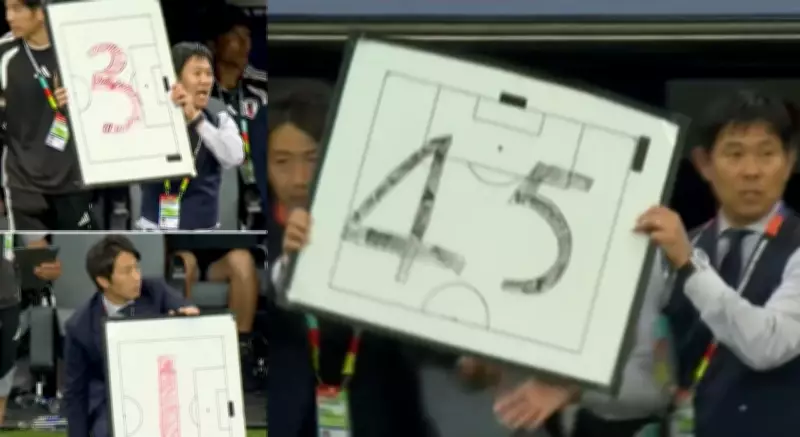
Japan's head coach Hajime Moriyasu revealed that the whiteboard he and his staff held up during the World Cup match against the Netherlands was simply a tool to show players how much time remained, not a coded tactical system. The explanation came ahead of Japan's second Group F match against Tunisia, which was the 1,000th fixture in FIFA World Cup history.
Whiteboard Used to Display Match Time
During the opening Group F match against the Netherlands, television cameras repeatedly captured Moriyasu and his staff holding a whiteboard with large handwritten numbers like 45, 3, and 1. Social media quickly speculated that Japan was using coded tactical instructions or sophisticated sideline communication systems. However, speaking before the Tunisia match in Monterrey, Moriyasu clarified the board's purpose.
"It's to let the players know how much time (is left) or what the time is," the 57-year-old told his press conference. "There's a large screen, but it's right on top of us. The time was displayed there, but the players had to look up towards the roof." Moriyasu explained that many players struggled to see the stadium clock while concentrating on the match and repeatedly asked the coaching staff for the time. He added, "I could shout it but they couldn't hear us, and I couldn't sign it to them, so I decided to write the time down on the whiteboard and I thought that would be the easiest way for them."

Japan vs. Tunisia: The 1,000th World Cup Match
Japan entered the match after a 2-2 draw with the Netherlands in Dallas, while Tunisia aimed to recover from a 5-1 defeat to Sweden. The stakes were high: Tunisia fought for tournament survival, and Japan sought to strengthen their knockout stage position. To commemorate the historic occasion, FIFA head of refereeing Pierluigi Collina presented match referee István Kovács with a special jersey featuring gold sleeve stripes and a "Match 1000" gold patch.
Comparisons with American Football Sideline Signals
Observers noted similarities between Moriyasu's board and the communication methods used in American football, where coaches use signs, whiteboards, and visual signals to relay instructions. Notable coaches like Nick Saban, Kirby Smart, Mario Cristobal, and Dabo Swinney have used elaborate systems with cartoons, emojis, and symbols to transmit information without revealing tactics. However, Japan's approach was simpler. As observers noted, "With Moriyasu, Japan doesn't use the flashy emojis or complex signals. A single sign with a number on it does the trick for the Blue Samurai."
Why Fans Thought It Was More Complex
Fans speculated about deeper tactical meanings due to Japan's association with structured, data-driven methodologies. When viewers saw specific numbers displayed during the Netherlands match, many interpreted them as coded formations or strategic messages. In reality, Moriyasu was simply helping his players keep track of the clock.