World Cup Hero Vozinha Exposes Overvaluation in Indian Football
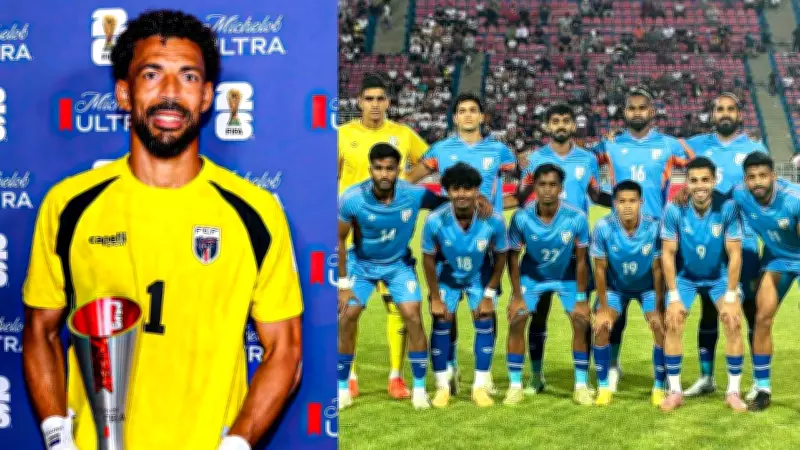
NEW DELHI: The opening round of group-stage matches at the 2026 FIFA World Cup delivered theatre of the highest order. From Morocco schooling Brazil with their silky, eye-pleasing football, to Lionel Messi’s hat-trick against Algeria, and Cristiano Ronaldo’s Portugal failing to find a winner against Congo, the opening gameweek had it all. Yet, one of the most jaw-dropping moments came when Cabo Verde’s 40-year-old goalkeeper, Josimar José Évora Dias, popularly known as Vozinha, left one of world football's heavyweights scratching their heads.
Seven saves against Spain were enough to spoil a perfect start for the Spanish armada, securing a historic 0-0 draw on Cabo Verde’s World Cup debut and earning Vozinha the coveted Man of the Match award. Currently playing for GD Chaves in the Portuguese second tier, Vozinha became an overnight sensation.
As he made headlines for the footballing heroics, thousands of miles away in India, the same goalkeeper initiated a fierce, uncomfortable debate online.

Vozinha's Market Value Stands at Rs 40 Lakh
As highlight clips of Vozinha’s performance went viral, frustrated Indian football fans, many of whom have seen their hair turn grey waiting for India to fulfil their dream of playing at a World Cup, pointed out a staggering anomaly. According to Transfermarkt, a digital database that tracks global football statistics and player market values, the veteran keeper's market value is just Rs 40 lakh. On the other hand, members of the recent Indian national squad picked by head coach Khalid Jamil for the Tajikistan friendlies command valuations twice, thrice, or even four times higher, despite being nowhere near World Cup qualification.
If it is put into numbers, the Indian squad carries an average market value of Rs 1.46 Crore, with the absolute lowest baseline standing at Rs 80 Lakh for players like Rahul Bheke and Pramveer. Even India's goalkeeping trio of Gurpreet Singh Sandhu, Albino Gomes, and Hrithik Tiwari command market values of Rs 1.4 Crore, Rs 1.4 Crore, and Rs 1.8 Crore, respectively. For those making the comparison, the argument was as clear as white paper that Indian players are drastically overvalued compared to a proven World Cup protagonist.
How Does Transfermarkt Calculate Market Value?
To understand this disconnect, one must look at how Transfermarkt calculates these figures. The platform does not employ a pure performance algorithm. Instead, it relies on the wisdom of the community, whose members evaluate expected player value within a free market. Individual transfer modalities and situational conditions are heavily factored into the calculation rather than predicting an exact future transfer fee. And that is how a player’s valuation becomes a reflection of local market demand, league-specific financial parameters, and the purchasing power of domestic clubs, rather than a direct indicator of international quality.
What Do the Experts Say?
Former Indian international Robin Singh believes the responsibility for these valuations falls squarely on the clubs rather than the players themselves. "I'm very happy for Vozinha, who had a great performance. The comparison to the Indian market, I feel, is a question that is relevant to the clubs," Singh told TimesofIndia.com during an exclusive interaction. "It depends on how much a player is in demand and how much money the club is willing to pay for him. If the club in the Indian market feels a goalkeeper is worth a lot more, I think they're the ones that have to be asked this question about the market valuation."
Former India midfielder Mehtab Hossain, however, takes a more critical view of the disparity. Pointing out that Vozinha is already 40 and well past his peak years, Hossain argues that market value is also a reflection of a player's stage in his career. Take the example of Sandesh Jhingan, whose current market value stands at Rs 2 crore but was significantly higher at Rs 2.4 crore three years ago. In Vozinha's case, he had his highest market value of Rs 4.8 crore at the age of 31. However, while delving deeper into the issue, he could not help but admit that some players' valuations in the Indian market are indeed inflated.

"The football money depends on many factors," Hossain told this website. "And here, for clubs like East Bengal or Mohun Bagan, what is happening now, especially with the pressure (of signing a particular player), I think player valuations are increasing. There is pressure that we have to build a good team, we have to fight for championships, and what happens to the country's football doesn't matter. What matters is that if I want this player, I will take him at any cost, and that inflates the price."
Beyond age and career trajectory, Hossain believes the inflation in Indian football is being fuelled by structural issues and aggressive agent manoeuvring, with beneficiaries often exploiting the intense competition among clubs. "The player agent will say, 'My player has an offer from East Bengal', although there may not be any offer in reality. Agents also earn from this. Some of the damage has been caused because of agents. I mean, with due respect, agents should also think about this. You are filling your pockets, but only the clubs know how much they are suffering."