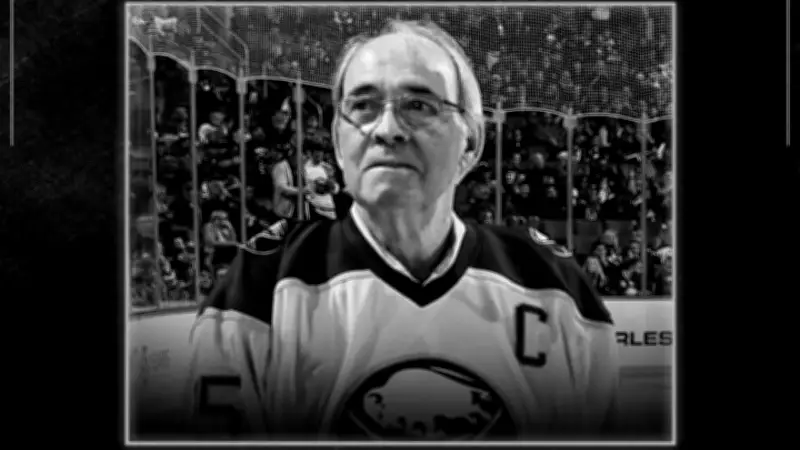
Gerry Meehan, one of the rare figures who helped build the Buffalo Sabres on the ice and from the front office, died Friday, June 5, at 79. The Sabres announced his death and said the thoughts of the organization were with his friends and family.
Meehan was not just a former player with a title next to his name. He was part of the Sabres' first team, became the second captain in franchise history, later served as general manager, and helped pull off moves that still sit inside Buffalo's hockey memory.
Gerry Meehan's Sabres legacy started with the franchise's first team and first playoff berth
The Sabres selected Meehan in the 1970 expansion draft, and he quickly became part of the team's foundation. According to Sabres.com's Jourdon LaBarber, Meehan ranked third on the team in goals and points during Buffalo's inaugural season and earned the first assist in franchise history.

Buffalo named Meehan its second captain the next season. He held that role until October 1974, and his captaincy included the Sabres' first playoff appearance in 1972-73. That season also marked the best scoring year of his NHL career, with 31 goals.
Years later, Meehan explained why Buffalo changed his career.
"The idea that an expansion team was coming - not only to Buffalo - but close to my home in Toronto, and to be selected by them and get a chance to play as an NHL regular, obviously made my career," Meehan said. Meehan played 10 NHL seasons with the Toronto Maple Leafs, Philadelphia Flyers, Sabres, Vancouver Canucks, Atlanta Flames and Washington Capitals. He later earned a law degree from the University at Buffalo and returned to the Sabres' front office in 1984 under general manager Scotty Bowman.
That move mattered. Meehan replaced Bowman as Buffalo's fourth general manager during the 1986-87 season. His second act became just as important as his first.
Meehan's front office run gave Buffalo Alexander Mogilny, Pat LaFontaine and Dominik Hasek
Meehan's run as general manager included trades for Pat LaFontaine, Dale Hawerchuk and Dominik Hasek. He also helped bring Alexander Mogilny to the NHL after the winger defected from the Soviet Union in 1989.
That was not a routine transaction. Meehan and Don Luce, then Buffalo's director of player development, traveled to Stockholm, Sweden, to meet Mogilny and guide him through the process while avoiding the KGB's reach, according to Sabres.com.
Mogilny thanked both men during his Hockey Hall of Fame induction last November.
"You were my guiding lights when I came into the NHL," Mogilny said.
Meehan also protected that vision when he traded for LaFontaine in 1991. He later said New York Islanders general manager Bill Torrey wanted Mogilny in the deal. Meehan refused.
"I said, 'Well, that's why I'm trading for LaFontaine, to play with Mogilny. So, it's Turgeon or it's not going to happen,'" Meehan recalled. "That's what really closed it."
The result aged brutally well for Buffalo. LaFontaine posted 148 points in 1992-93, and Mogilny scored 76 goals. Both remain Sabres franchise records.
Meehan's trade for Hasek also became one of the sharpest moves in league history. Hasek arrived as a backup from Chicago and became a six-time Vezina Trophy winner and two-time Hart Trophy winner in Buffalo.
Meehan once explained what he saw before most of the league did. "He was their goalie and I think they played the Russians, but he faced something like 100 shots and they either tied or won, 2-1," Meehan recalled. "I said, 'He's unconventional, he's athletic, he's wiry, and he stops the puck as much as possible of any human being as a goalie.'"
Meehan remained in Buffalo's front office through the 1995-96 season. He later stayed active with the Sabres Alumni Association and entered the Greater Buffalo Sports Hall of Fame in 2023.
He is survived by his wife, Mirella; children Dan, Adam and Kate; and grandchildren Christian, Alexander, Nathan and Juniper.