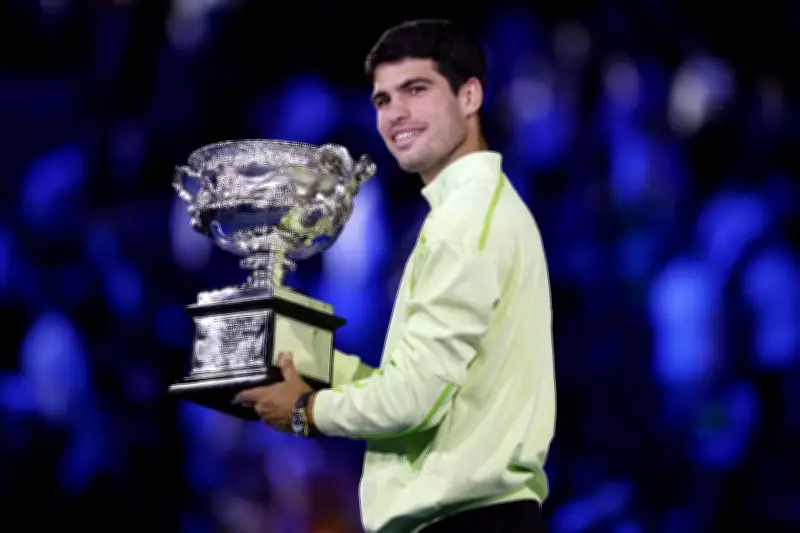
Alcaraz Creates History with Australian Open Victory Over Djokovic
In a stunning display of resilience and skill, Carlos Alcaraz etched his name into tennis history by defeating the legendary Novak Djokovic to claim his first Australian Open title. The world number one overcame a challenging start to secure a 2-6, 6-2, 6-3, 7-5 victory at Rod Laver Arena, lifting the Norman Brookes Challenge Cup for the first time in his career.
Youngest Career Grand Slam Champion Emerges
At just 22 years and 272 days, Alcaraz has become the youngest man in tennis history to complete a career Grand Slam. This remarkable achievement adds to his growing legacy as he continues to rewrite the record books with his seventh major title. The Spanish sensation arrived in Melbourne amidst significant personal and professional challenges, having recently parted ways with long-time coach Juan Carlos Ferrero in December.
"Nobody knows better than my team how hard I've been working to get this trophy," Alcaraz reflected after his triumph. "Pre-season was a bit of a rollercoaster emotionally. We did the right work, you pushed me every day to do the right things and I'm really grateful for everyone in my corner. This trophy is also yours."

Strategic Mastery Overcomes Djokovic's Experience
The final unfolded as a fascinating tactical battle between tennis's established champion and its rising star. Alcaraz signaled his intent early with precisely executed drop shots designed to test Djokovic's movement. Despite Djokovic's clinical start, winning the first set in just 33 minutes, Alcaraz demonstrated remarkable composure to adjust his strategy.
As the match progressed, several factors influenced the contest:
- Weather Conditions: The coldest day of the fortnight saw temperatures peak at just 20 degrees Celsius with strong winds gusting up to 29 mph, creating unpredictable playing conditions
- Crowd Dynamics: For the first time in his young career, Alcaraz found himself facing a crowd that largely favored his opponent, with Spanish legend Rafael Nadal among those cheering him on
- Physical Challenges: Djokovic required medical attention for apparent acid reflux issues during the third set, while Alcaraz maintained his physical intensity throughout
Serve Evolution Proves Decisive
A crucial element in Alcaraz's victory was his improved serve, which he has consciously refined by studying elements of Djokovic's technique. The statistics reveal the effectiveness of this evolution:
- Alcaraz won 77 percent of points on his first serve
- Djokovic managed only 66 percent on his first serve
- Alcaraz converted 5 of 16 break point opportunities
- Djokovic saved 11 break points through sheer determination
Rather than relying solely on power, Alcaraz has developed a cleaner, more repeatable service motion focused on disguise and placement. This technical refinement proved particularly valuable during pressure situations, allowing him to protect his service games effectively against one of tennis's greatest returners.
Overcoming Adversity to Claim Victory
The path to this historic triumph was anything but straightforward for Alcaraz. Beyond the coaching change that preceded the tournament, he faced multiple challenges during the final itself. When the roof began closing during the second set, Alcaraz protested to the chair umpire but maintained his focus, carrying momentum into the crucial third set.
Djokovic mounted a spirited resistance in the fourth set, saving six break points in one dramatic game through sheer willpower. The 38-year-old champion traded shots with his younger opponent, buoyed by supportive crowds both inside Rod Laver Arena and outside in the biting Melbourne cold. However, Alcaraz's persistence ultimately prevailed as he broke Djokovic's serve in the twelfth game to secure the championship.

This victory represents more than just another major title for Alcaraz. It demonstrates his ability to absorb lessons from tennis's greatest champions while developing his own distinctive style. Standing at 6 feet tall—making him the shortest among modern tennis greats—Alcaraz has proven that technical evolution and strategic intelligence can overcome physical disadvantages against the sport's most formidable opponents.