Nishesh Basavareddy's 'Choke' Celebration Ignites Tennis Debate
The Australian Open qualifiers witnessed a moment that quickly went viral. Nishesh Basavareddy, a 20-year-old American tennis player of Indian heritage, made a stunning comeback from 1-7 down in a tie-breaker against Austria's Sébastien Ofner. His victory celebration featured the controversial 'choke' gesture, sparking intense debate across the tennis world.
Dramatic Comeback Victory
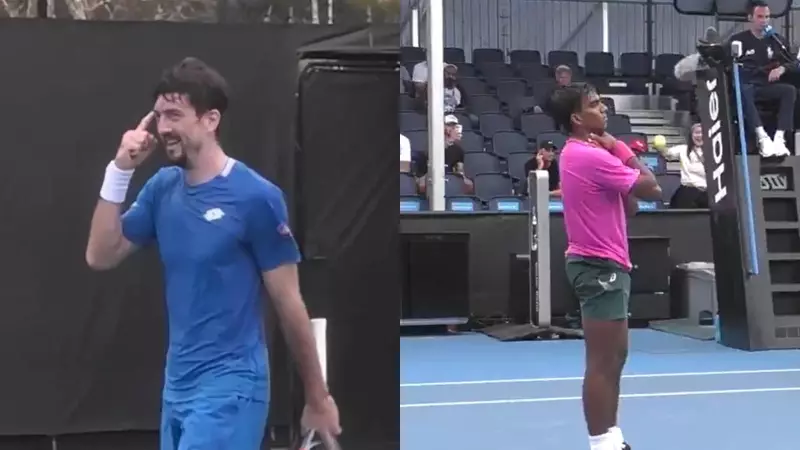
Basavareddy faced elimination when Ofner led 7-1 in the third set tiebreak. The Austrian player mistakenly believed he had won the match, celebrating prematurely. The chair umpire had to inform him that qualifying matches use a 10-point tiebreak system. This misunderstanding set the stage for an incredible turnaround.
The young American fought back from the brink of defeat. He leveled the score at 8-8, then saved a match point at 9-10. The dramatic sequence continued with Basavareddy eventually winning 13-11. His immediate celebration crossed his arms over his throat in a choking motion, mimicking NBA legend Reggie Miller's famous gesture.

Divided Reactions Across Tennis Community
The 'choke' celebration immediately polarized tennis fans and commentators. Some criticized Basavareddy for mocking his opponent's unfortunate mistake. They called the gesture classless and unsportsmanlike. Others defended the young player, praising his fighting spirit and dramatic comeback under extreme pressure.
Basavareddy addressed the situation after the match. "In a super tie-break, you always have a chance, so I kept believing," he told the Australian Open website. "I saw him tense up a little bit, but the balls were quite old there, so every rally was a war."
Historical Context of the Gesture
The 'choke' gesture originated with NBA star Reggie Miller during the intense rivalry between Indiana Pacers and New York Knicks. Miller famously directed the motion at filmmaker Spike Lee in 1994 after clutch performances. The gesture has seen recent revival by current NBA player Tyrese Haliburton.
Basavareddy's use of this basketball celebration in tennis created unexpected controversy. Tennis traditionally emphasizes sportsmanship and respect for opponents, making such demonstrative celebrations rare in the sport.
Backing Up With Another Victory
The debate continued as Basavareddy secured his place in the Australian Open main draw. He followed his dramatic win over Ofner with another comeback victory against Britain's George Loffhagen. After dropping the first set 5-7, Basavareddy fought back to win 6-4, 6-4.
This qualification marks a significant achievement for the California-born player. He reached a career-high ranking of World No. 99 in June last year but has since dropped to No. 239. His Australian Open debut in 2025 saw him take a set off Novak Djokovic, earning praise from the tennis legend.
Expert Opinions and Future Prospects
Djokovic previously commented on Basavareddy's potential. "I saw that he's very quick. He's a very talented player. He's got great hands. He's very dynamic," the 24-time Grand Slam champion said. "He can serve well, hit spots. Just a very complete game overall."
Former world No. 1 Mats Wilander also praised the young American. "First impression was brilliant. The technique was similar to Novak's," Wilander told Eurosport. "The forehand was very similar. A better forehand than Novak had when Novak was at his age."
Ofner's Painful History
The loss was particularly painful for Sébastien Ofner, who has experienced similar collapses before. In 2023 at Kitzbuhel, he led Alex Molcan 6-4, 5-0 before losing seven consecutive games and eventually the match. Tennis media described Wednesday's meltdown as déjà vu for the Austrian player.
Ben Rothenberg called the match "the wildest ride of Aus Open," while other tennis commentators labeled Ofner's rule confusion as "insanity."
Looking Ahead
Basavareddy now prepares to face Australia's Christopher O'Donnell in the main draw. His journey through qualifying has been marked by dramatic comebacks and controversial celebrations. The tennis world continues to debate whether his 'choke' gesture represents poor sportsmanship or justified celebration of an incredible comeback.

The young player carries the momentum of two comeback victories into his first Australian Open main draw appearance. His performance will be closely watched by both supporters and critics of his celebratory style.