CEO's Cab Ride Revelation Ignites Debate on Dating Apps and Social Hierarchy
In the bustling urban landscape of Gurugram, where life moves at the speed of swiping fingers and cabs weave through congested streets, a chance encounter has illuminated how dating applications are fundamentally reshaping social interactions. These platforms, once viewed as mere tools for connection, are now being hailed as powerful equalizers that dismantle traditional barriers like profession and neighborhood, creating new pathways for human relationships in India's digital age.
The Viral Discovery That Shocked a Tech Founder
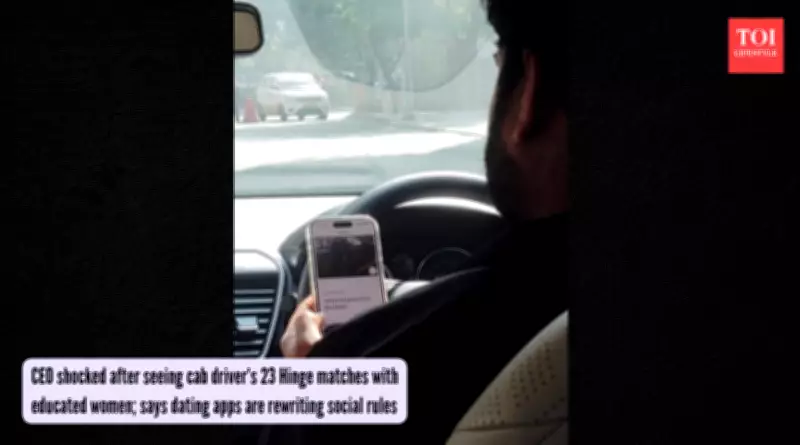
Jasveer Singh, co-founder and CEO of Knot Dating, recently shared an extraordinary experience on social media platform X that rapidly captured widespread attention. During a routine cab ride in Gurugram, Singh noticed the driver actively scrolling through the popular dating app Hinge. Driven by what he described as "pure founder curiosity," Singh requested to view the profiles, to which the driver amiably agreed.
The revelation was astonishing: the cab driver had accumulated 23 matches on the platform, with many of the women appearing to be well-educated professionals employed at reputable companies with strong career trajectories. This visual evidence challenged conventional assumptions about who attracts attention in the digital dating sphere.

Reflecting on this encounter, Singh made a bold declaration: dating apps have effectively "collapsed social hierarchy." He elaborated with a business analogy, stating, "When access changes, markets break," suggesting that these platforms are disrupting long-standing social structures by providing unprecedented access to potential partners regardless of background.
Social Media Erupts with Diverse Perspectives
The post triggered a vigorous online debate about class, attraction, and the role of technology in modern relationships. Supporters of the equalizing effect celebrated the development, with one user noting, "Algorithms don't care about background," while another emphasized, "Dating is not an elite privilege anyway, and the internet is not restricted to social media."
Some commentators attributed the phenomenon to shifting priorities in casual dating. A user argued, "That's because people are there to have fun... pure biological attraction remains," implying that status becomes less relevant when the goal is short-term connection. Another added a nuanced view: "People don't look for rich as much as they look for hot when they are looking for casual hookups. For marriage, they look for rich more than hot. Different markets."
Amid the praise, skepticism also surfaced. Doubters questioned the authenticity of the matches, with one commenter expressing suspicion: "Driver matches with women with strong careers. Something not right. Would love to see what info he had put in his profile." Others marveled at the driver's tech-savviness, noting, "Driver having an iPhone, using Hinge with more than 23 matches! Bro is on a whole different level."
The Broader Implications for Indian Society
This incident underscores a larger trend in urban India, where dating apps are increasingly becoming integral to social life. In fast-paced cities like Gurugram, characterized by hectic schedules and digital immersion, these platforms offer a convenient alternative to traditional meeting methods, bypassing what Singh referred to as "usual gatekeepers."
The story highlights how technology is not merely connecting individuals but actively rewriting social rules. By prioritizing factors like mutual interests, physical attraction, and personal compatibility over rigid hierarchies, dating apps are fostering a more inclusive environment where connections can flourish across previously impermeable divides.
As debates continue to rage online, one thing is clear: the landscape of romance and relationships in India is undergoing a profound transformation, driven by the swipe of a finger and the algorithms that power our digital interactions.