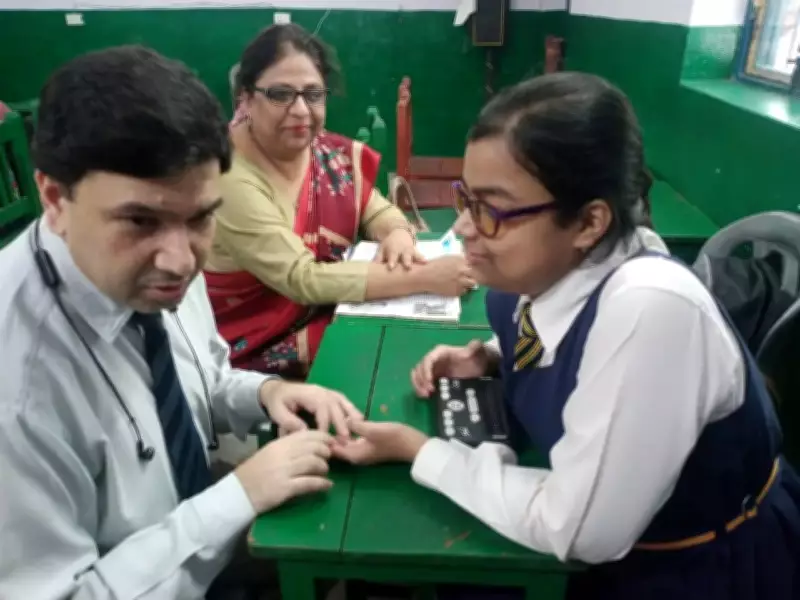
In a remarkable achievement, Sarah Moin, a Class 12 student who is deaf-blind, topped Christ Church College in Lucknow with an outstanding 98.75% in the Council for the Indian School Certificate Examination results announced on Thursday. Her success has been hailed as a collective triumph, shaped by determination, innovation, and sustained institutional support.
A Team Effort Behind the Success
Sarah's performance was made possible through the dedicated efforts of her visually impaired teacher and special educator Salman Ali Qazi, principal Rakesh Kumar Chattree, and the school's teaching staff. Over the years, they worked together to ensure she could study in the mainstream and compete on equal terms with her peers.
The Role of Special Educator Salman Ali Qazi
Qazi, a gold medallist in BEd (Special Education) from Dr Shakuntala Misra National Rehabilitation University, has been central to Sarah's academic journey. He gradually lost his vision after completing a law degree from Lucknow University but continued to pursue special education and became Sarah's guide from her early school years.

“Since she could not hear, see, or speak, it was not possible for a mainstream teacher to teach her. So, as a special educator, I taught her by spelling words into her hands. Till Class 2, she could partially hear with the help of hearing aids, so I taught her Braille. That helped her identify letters and form words and short sentences,” Qazi explained.
He taught Sarah individually in the school's special resource classroom from Class 1 to Class 8. As she advanced and began preparing for board examinations, Qazi took on the role of communicator between her and subject teachers. To explain concepts, he relied on touch-based methods and everyday objects. Coins, balls, and oranges were used to teach astronomy and geography. “To teach her rotation and revolution of Earth, I used oranges and made her understand through the touch method. Similarly, to teach planets in the solar system, I used coins as the sun and balls of different sizes to teach planets,” he said.
School-Wide Support and Innovative Methods
From Class 9 onward, principal Chattree and Qazi developed a timetable that allowed mainstream teachers to teach Sarah individually during free periods. Teachers volunteered their time, delivering lessons as they would in regular classrooms, while Qazi translated them into tactile communication and conveyed Sarah's questions back to them.
For examinations, question papers were provided on a pen drive and accessed through a laptop connected to a refreshable Braille display. Sarah read the content through touch and wrote responses using assistive devices, after which Qazi converted them into standard answer sheets for board evaluation.
Principal Chattree noted that Sarah was the school's first special student and that the institution now has 33 such students. He said his goal was always to ensure children with disabilities studied alongside others rather than in isolation. “They are no less than anyone else, and Sarah has proved that,” he said.
Assistive Technology in Education
Sarah was initially taught through Braille and later through tactile fingerspelling. For board preparation, refreshable Braille displays and an Orbit Reader were used, enabling real-time reading and writing through touch. These technologies played a crucial role in her academic success.