

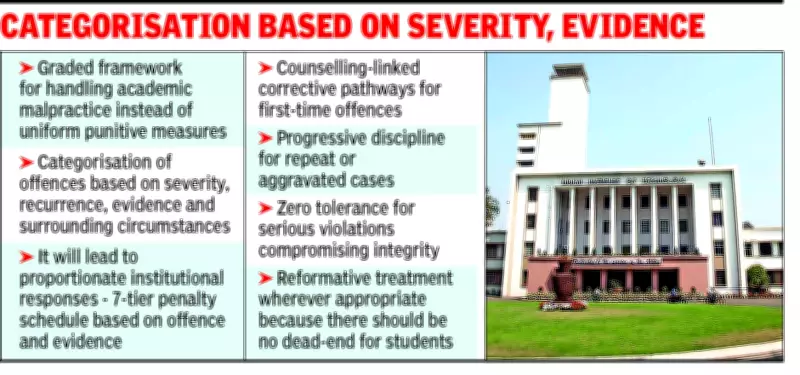
Kolkata: IIT Kharagpur has announced a significant shift in its approach to handling examination malpractice by implementing a graded framework of punishments. This new system replaces the earlier uniform punitive norms, aiming to ensure fair and proportional consequences while providing students with opportunities for reform.
Key Features of the New Framework
Director Suman Chakraborty stated, "We have zero tolerance for serious violations compromising integrity, but we will also provide corrective pathways to students to reform themselves." The institute's Special Senate approved a seven-tier penalty schedule on May 22, categorizing offenses based on severity, recurrence, evidence, and surrounding circumstances.
Seven-Tier Penalty Schedule
The punishments are designed to be proportionate. For instance, if a student is found with a mobile phone, smartwatch, or chits within a few minutes of the exam start without substantial evidence of use, the first answer script is scrapped, and a warning is issued. The student then receives a second answer script. If such items are discovered after an hour or more but without evidence of use, the answer script is discarded, but the student can take a supplementary exam.

For more severe offenses, such as being caught red-handed with evidence of cheating, the answer script is not evaluated, and the student is barred from supplementary exams. The final grade is based on remaining exam components. Leaking a question paper via mobile or other means leads to subject de-registration and a financial penalty, with no supplementary exam option.
Repeat offenders face escalating consequences, ranging from subject de-registration to home rehabilitation for a semester, financial penalties, and community service.
Rationale Behind the Change
A teacher explained, "Any malpractice is bad, but since there are different grades of offenses, punishments should also be graded. The aim is to ensure fairness and proportionate institute response so that there is no dead-end for students." Previously, a first-time offender with smart gadgets would be de-registered from the subject and lose the chance for a supplementary exam that year. Repeat offenses led to semester de-registration or a year lag, causing severe academic harm.
An institute official added, "To enforce discipline with dignity among students and provide a reformative pathway, the director, dean of student well-being, chief of staff, and others developed this graded system. It allows students to learn from mistakes without derailing their overall progress."
Background
In April, TOI reported that the institute had beefed up security measures, deploying additional personnel for frisking during exams following 300 complaints of academic malpractice involving smart gadgets.

Examples of Penalty Schedules
- Warning issued, first answer script scrapped; second provided if caught within minutes. If caught after an hour, answer script scrapped, supplementary exam allowed.
- Caught red-handed: answer script not evaluated, no supplementary, final grade from remaining components, community service required.
- Subject de-registration, no supplementary, financial penalty for question paper leak via smart gadget.
- Repeat offenses: subject de-registration to home rehabilitation for a semester, financial penalty, no supplementary, community service.





