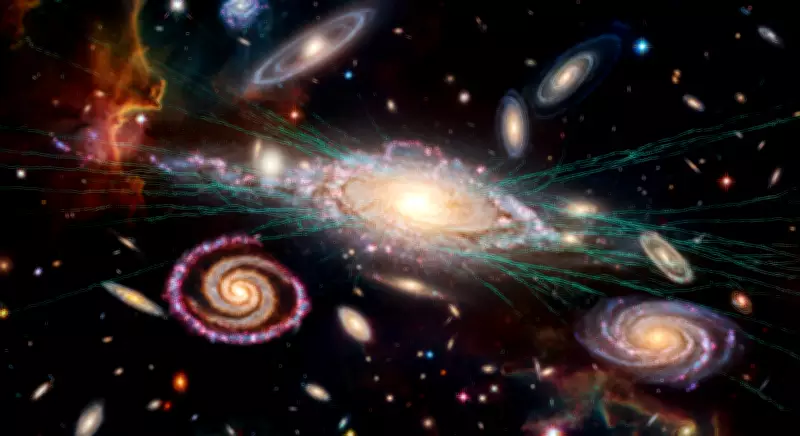
On clear nights, the Milky Way appears vast beyond imagination, stretching like a river of stars across the darkness. Yet modern astronomy has revealed a humbling truth: our galaxy is only a tiny part of something far larger. Deep within the universe lies the Laniakea Supercluster, an immense cosmic structure spanning roughly 500 million light-years and containing around 100,000 galaxies. Rather than existing as isolated islands, galaxies are woven into vast networks connected by gravity, forming a cosmic web that shapes their movements across space. Within this enormous system, galaxies flow along invisible gravitational pathways towards a mysterious region known as the Great Attractor. The discovery of Laniakea transformed astronomers' understanding of our cosmic address, revealing that the Milky Way is merely one thread in an unimaginably vast and interconnected universe.
Laniakea Supercluster Explained: The Vast Cosmic Web Holding 100,000 Galaxies
According to researchers from the Institute for Astronomy, University of Hawaii, Honolulu, the Laniakea Supercluster is one of the largest known structures associated with our galaxy's cosmic neighbourhood. Its name comes from the Hawaiian language and means "immense heaven" or "spacious heaven", reflecting its extraordinary scale. The supercluster was formally identified in 2014 by the team of astronomers analysing the peculiar motions of galaxies. Instead of examining galaxies solely by their positions, researchers mapped how they move under the influence of gravity, revealing a vast interconnected basin of attraction.
In the landmark study published in Nature, the research team described Laniakea as: "We define a supercluster to be the volume within such a surface, and so we are defining the extent of our home supercluster, which we call Laniakea." The study estimated that the structure contains approximately 100,000 galaxies distributed across a region about 500 million light-years in diameter. According to the researchers, galaxies within this region are not randomly scattered. Their motions are influenced by shared gravitational flows that define the boundaries of the supercluster.

Why Thousands of Galaxies Are Moving Towards the Mysterious Great Attractor
One of the most fascinating features of the Laniakea Supercluster is that its galaxies appear to be moving towards a common gravitational destination known as the Great Attractor. The Great Attractor is not a single object but a region of enhanced mass concentration that influences the motion of galaxies across hundreds of millions of light-years. Although much of it lies behind the dense plane of the Milky Way, making observations difficult, astronomers can measure its influence through galaxy velocities.
According to observations conducted by the National Radio Astronomy Observatory: "The Great Attractor exerts a gravitational pull on our galaxy and other galaxies." The gravitational attraction arises from enormous concentrations of visible matter, dark matter and galaxy clusters. These structures collectively shape the large-scale flows observed throughout the local universe. Modern surveys suggest that galaxies travel along filament-like structures within the cosmic web, funnelling matter towards dense regions where gravity is strongest.
How the Cosmic Web Reveals Our Place in the Universe's Grand Design
The discovery of Laniakea provided compelling evidence for one of cosmology's most important ideas: the universe is organised into a vast cosmic web. Rather than being evenly distributed, galaxies gather into interconnected filaments, sheets and clusters separated by enormous cosmic voids. These structures emerged over billions of years through the action of gravity on matter following the Big Bang. Observations from major galaxy surveys show that these filaments stretch across hundreds of millions of light-years, linking galaxy clusters into some of the largest known structures in the observable universe.

Within this framework, the Milky Way occupies a remarkably modest position. Our galaxy is part of the Local Group, which belongs to the Virgo Cluster's wider gravitational environment, itself embedded within the immense Laniakea Supercluster. Seen from this perspective, the Milky Way is not the centre of anything. It is a single galaxy among billions, connected through a vast network of matter and gravity that extends across the cosmos.
The Laniakea Supercluster offers one of the most profound perspectives on humanity's place in the universe. Spanning around 500 million light-years and containing roughly 100,000 galaxies, it reveals that our Milky Way exists within a gigantic cosmic web shaped by gravity and time. As galaxies stream towards the Great Attractor along vast filaments of matter, they expose the hidden architecture of the universe itself. What appears enormous on a human scale becomes surprisingly small when viewed through the lens of modern cosmology, reminding us that our galaxy is only one thread in an extraordinary cosmic tapestry.
About the Author
The TOI Science Desk stands as an inquisitive team of journalists, ceaselessly delving into the realms of discovery to curate a captivating collection of news, features, and articles from the vast and ever-evolving world of science for the readers of The Times of India. Consider us your scientific companion, delivering a daily dose of wonder and enlightenment. Whether it's the intricacies of genetic engineering, the marvels of space exploration, or the latest in artificial intelligence, the TOI Science Desk ensures you stay connected to the pulse of the scientific world. At the TOI Science Desk, we are not just reporters; we are storytellers of scientific narratives. We are committed to demystifying the intricacies of science, making it accessible and engaging for readers of all backgrounds. Join us as we craft knowledge with precision and passion, bringing you on a journey where the mysteries of the universe unfold with every word.