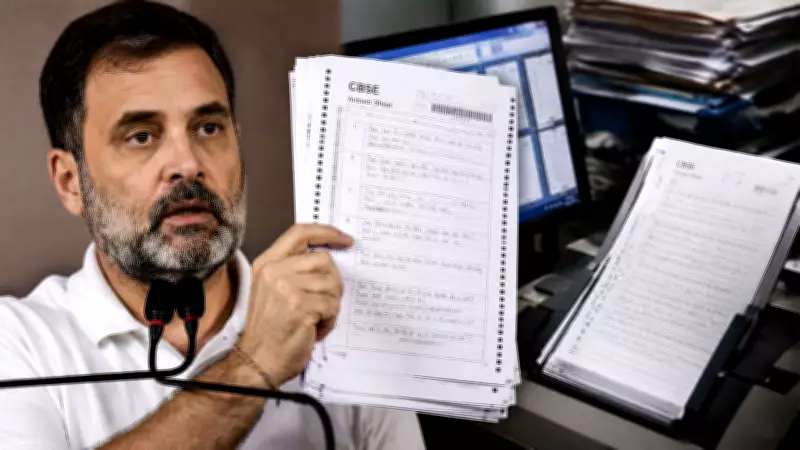
Rahul Gandhi has intensified his attack on the Central Board of Secondary Education (CBSE) over the Class 12 On-Screen Marking (OSM) controversy, alleging that answer sheets were scanned using mobile phones after key tender requirements were diluted. The row has deepened amid widespread student complaints of blurred scans, missing pages, evaluation errors, and cybersecurity vulnerabilities in the digital marking system.
Background of the Controversy
The CBSE implemented the On-Screen Marking system for Class 12 examinations to streamline evaluation and reduce manual errors. However, the process has been marred by technical glitches and allegations of improper implementation. Students have reported that scanned answer sheets appeared blurry or incomplete, leading to errors in grading. Additionally, concerns about data security and privacy have been raised, with experts pointing to potential vulnerabilities in the digital platform.
Rahul Gandhi's Allegations
Congress leader Rahul Gandhi has accused the CBSE of compromising quality by relaxing tender specifications for scanning equipment. He claimed that instead of using high-resolution scanners, mobile phones were employed to capture images of answer sheets, resulting in poor quality scans. Gandhi demanded a thorough investigation into the matter and called for accountability from the education ministry.

“The CBSE has failed our students by cutting corners in the evaluation process. Using mobile phones to scan answer sheets is unacceptable and undermines the credibility of the examination system,” Gandhi said in a statement.
Student Complaints and Cybersecurity Risks
Students across the country have voiced frustration over the OSM system, citing instances where entire pages were missing from scanned copies. Some have reported that their marks were incorrectly calculated due to evaluation errors. Cybersecurity experts have also flagged concerns about the platform’s vulnerability to hacking and data breaches, potentially exposing sensitive student information.
In response, the CBSE has defended the system, stating that it has robust security measures in place and that any errors are being rectified. However, the board has not directly addressed the allegations regarding mobile phone scanning.
Political Reactions
The controversy has sparked a political firestorm, with opposition parties demanding a parliamentary inquiry. The Congress party has accused the government of negligence and prioritizing cost-cutting over student welfare. Meanwhile, the ruling Bharatiya Janata Party (BJP) has dismissed the allegations as baseless, accusing Gandhi of politicizing a technical issue.
Education Minister Dharmendra Pradhan has assured that the government will look into the matter and take corrective action if necessary. He emphasized that the OSM system was implemented after thorough testing and with the aim of improving efficiency.
Way Forward
As the row continues, students and parents are calling for a transparent review of the evaluation process. Many have demanded the option of physical re-evaluation or re-checking of answer sheets. The CBSE has yet to announce any major changes to the system, but sources indicate that the board may consider reverting to manual evaluation for pending cases.
The incident highlights the challenges of digitizing large-scale examination systems in India, where infrastructure gaps and technical limitations can exacerbate existing problems. Moving forward, experts recommend stricter quality checks, better training for evaluators, and enhanced cybersecurity protocols to prevent similar issues.