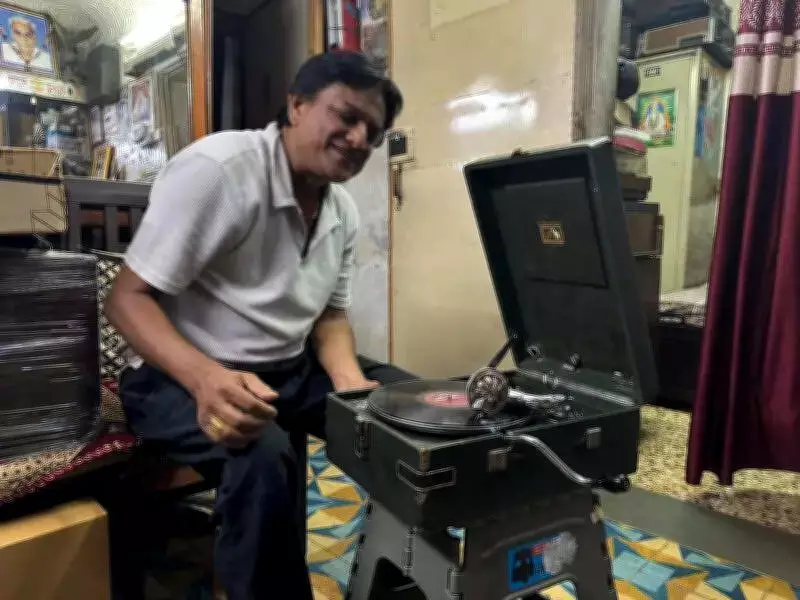
Ahmedabad: At 7:30 PM, the counter at Gujarat Gramophone LP House in Amraiwadi draws a diverse crowd, from retired government employees to college students, all inquiring about the latest vinyl releases such as the blockbuster 'Dhurandhar' or a Khayyam special LP. Sadguru Sharan, the owner of this shop—considered one of the few surviving formal record-only stores in Gujarat—welcomes the trend. With a collection of thousands of records accumulated over decades, Sharan notes a resurgence over the past 18 months. "For the past one and a half years, we have witnessed a resurgence of the trend of buying a gramophone or an electronic disc player and then scouting for the records of choice," he says. "It is not a light hobby. Records cost between Rs 1,000 and Rs 4,000. But connoisseurs of analog music see them as collector's items with a shelf life of decades."
Youth Embrace Analog
More notably, young people are flocking to these shops, driven by nostalgia for childhood or youthful experiences with gramophones. "Roughly one of every three to four records we sell goes to young listeners," Sharan adds. "Based on the records they order—from Shah Rukh Khan specials to 'Rockstar' and 'Rang De Basanti'—it is possible they belong outside the typical clientele associated with 1950s and 1960s Indian film music, ghazals, and classical music."
Legacy and Repair
On busy Gandhi Road near Manek Chowk, Ayub Shamsuddin, the third-generation owner of Gujarat Gramophone Repairing House, runs a shop distinguished by gramophones outside heralding the craft. Over time, the shop has expanded to repair all musical devices, from tape recorders to DVD players, while gramophones remain their specialty. "Ours is possibly the only repair shop for various brands of gramophones simply because spare parts like stylus or tonearm have accumulated over decades," says Shamsuddin. "In the 1960s-70s, there were about 10-15 gramophone and record shops in the city, with about five on Gandhi Road." He notes an uptick in gramophones received for repair and inquiries for restored units for sale. The shop's diverse vinyl collection includes tracks from Gujarati and Hindi plays and Gujarati Sugam Sangit, indicating analog music's cross-generational appeal. However, Shamsuddin laments that his sons work in the automobile sector: "My next generation might not be associated with gramophones."

Collector's Market
New-generation connoisseurs remain optimistic. Sharan acquired three vinyl records for 'Dhurandhar' as collector's editions, along with vinyl of films like 'Umrao Jaan', 'Sholay', 'Chhava', and 'Pushpa'. "All are gone, and demand for three more is pending. Almost all major labels are now making discs again," he says. "We are also sending vinyl to the US, the UK, Germany, and Japan, where collectors demand specific artists or genres. For locals, it is the charm of checking discs for quality."
Niche Cafes and Private Mehfils
Aficionados point to niche cafes and private mehfils where youngsters enjoy the soft crackle before a song, crystal-clear sound, and 'lossless' tracks that allow appreciation of each instrument in 'studio-quality' music. Divyansh Panchal, 18, is a new-age listener hooked through social media and peers. "Even though we can access music digitally from anyone, anywhere, the feel of listening on a gramophone is completely different. The analog sound connects in a way that digital doesn't," he says.

Gramophones: The Overture
- Originally known as the phonograph, the gramophone earned its official name in the 1920s. Today, the term loosely includes record players.
- The city is home to nearly 10-20 machines that may be 50-100 years old, according to estimates.
- In recent years, the number has increased, primarily in digital record players with built-in amplifiers, lacking the horn typical of early gramophones.
- Entry-level disc players start from about Rs 1 lakh and can go up to Rs 3-3.5 lakh depending on brand and features.
- Vinyl and shellac records, often crafted from lac, remain delicate. Discs start below Rs 1,000 and can exceed Rs 5,000 based on availability and demand.
- When exposed to heat, discs can bend, requiring careful vertical storage away from heat and moisture. With proper handling, discs can last decades. Many use vinyl records as decorative accessories to signify musical interest.
In Tune with the Classics
For Hemant Prajapati, 70, a gramophone is more than a device. "Gramophones are unique as they do not run on electricity, and the young generation always gets fascinated by how the mechanics work," he says. A legacy from his parents, he listens to favorite tracks regularly. "The sweetness or natural sound of a gramophone cannot be compared to the best speakers or players. I also have a radiogram, a blend of radio and record player with built-in amplifiers. The maintenance cost is very low if handled with good care."
Jitendra Patel, 65, highlights the technical charm. "My gramophone is about 40 years old. The gramophone is the only physical medium through which one can truly experience studio quality music. Clarity is so good that it feels like the artist is singing in front of me. I cannot expect that from digital mediums." He notes that new formats often fail to capture nuances like high and low pitches.
For Jayesh Mayatra, 63, gramophones link to the past. He owns three functional gramophones and maintains over 300 records, some older than half a century. "My father loved music, and that passion stayed with me. As a child, I used to sit with him and listen, and that's where it all began. Nostalgia keeps me invested."