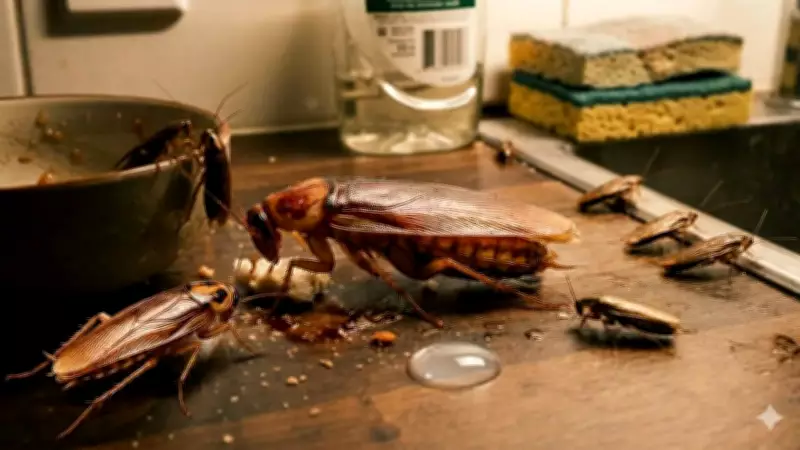
Cockroaches tend to unsettle people for obvious reasons, though their biology is often stranger than their appearance. One detail that repeatedly surprises people is the colour of their blood. Unlike humans and most vertebrates, cockroaches do not bleed red. Their internal fluid is pale, almost colourless, and under certain lighting can appear white or slightly creamy. The difference is not caused by albinism, disease, or a lack of iron. It comes from an entirely different way of moving oxygen through the body. Insects evolved around a respiratory system that bypasses many of the functions associated with blood in mammals, and cockroaches remain one of the clearest examples of how differently that system works.
Why cockroaches do not need red blood
In humans, blood is red because of haemoglobin, an iron-containing protein that transports oxygen from the lungs to tissues across the body. Cockroaches do not rely on that mechanism. Instead, oxygen enters through small openings along the sides of the body known as spiracles and travels through branching air tubes called tracheae.
According to the study titled 'Determining Hemolymph Volume of the Cockroach', insects can circulate internal fluids without depending on haemoglobin-based oxygen transport. The paper explains that oxygen reaches tissues directly through the tracheal network rather than being carried in the bloodstream itself. Because of that arrangement, the cockroach's circulating fluid, known as haemolymph, has no reason to contain large quantities of respiratory pigments. Without haemoglobin, the fluid loses the deep red appearance associated with vertebrate blood.

The result is a liquid that appears translucent, pale grey, or white depending on concentration and lighting.
Why cockroaches do not need oxygen-carrying blood
Although it is commonly compared to blood, haemolymph performs a somewhat different set of tasks. It moves nutrients around the body, carries chemical signals, removes certain waste materials, and plays a role in immune defence.
As per the study, haemolymph is part of an 'open circulatory system', meaning the fluid is not confined strictly within narrow blood vessels in the same way mammalian blood is. Instead, it flows more freely through body cavities and around internal organs before returning toward the heart structure located along the insect's back.
That circulation still matters. Cockroaches need internal pressure for moulting, limb movement, and tissue maintenance. The fluid also contains specialised cells involved in clotting and protection against pathogens. None of those functions requires the strong oxygen-binding chemistry that gives vertebrate blood its colour.
Why cockroaches never developed haemoglobin-rich blood
The absence of red blood in cockroaches is tied closely to size and evolution. Small-bodied insects can rely on direct airflow because oxygen does not need to travel long distances inside the body. Tracheal tubes handle most of the delivery work without needing oxygen carriers suspended in fluid.
As per the study, the insect respiratory system is efficient enough that haemolymph becomes secondary in respiration. That evolutionary separation shaped the chemistry of insect circulation over millions of years.
Larger animals face a different problem. Oxygen diffusion alone becomes too slow once body size increases, which is why vertebrates developed lungs, closed blood vessels, and oxygen-carrying proteins such as haemoglobin. Cockroaches never needed that transition.
The changing appearance of cockroach haemolymph
Haemolymph is not always clear. Diet, hydration, injury, and developmental stage can slightly alter its appearance. Freshly exposed haemolymph may look milky or faintly bluish before drying darker after contact with air and tissue compounds.
The research focused partly on measuring haemolymph volume in cockroaches for laboratory physiology work. Accurate measurement matters because the fluid influences pressure regulation and chemical balance inside the insect body.
The paper also highlighted how difficult insect circulation can be to study compared with vertebrate blood systems. Haemolymph behaves differently under stress, temperature shifts, and dehydration, particularly because it moves through an open cavity rather than a tightly sealed vascular network.

The evolutionary reason cockroaches kept pale haemolymph
There are exceptions across the insect world. Some aquatic larvae living in oxygen-poor environments possess haemoglobin-like pigments, giving their internal fluids a reddish tint. Certain arthropods outside the insect class use copper-based respiratory proteins called hemocyanins, which can appear blue. Cockroaches, though, remain typical terrestrial insects. Their pale haemolymph reflects a respiratory design that avoids blood-based oxygen transport almost entirely. The idea of 'white blood' sounds unusual largely because mammalian biology tends to dominate everyday understanding of anatomy. Insects operate under a separate blueprint. Cockroaches simply make that difference visible.