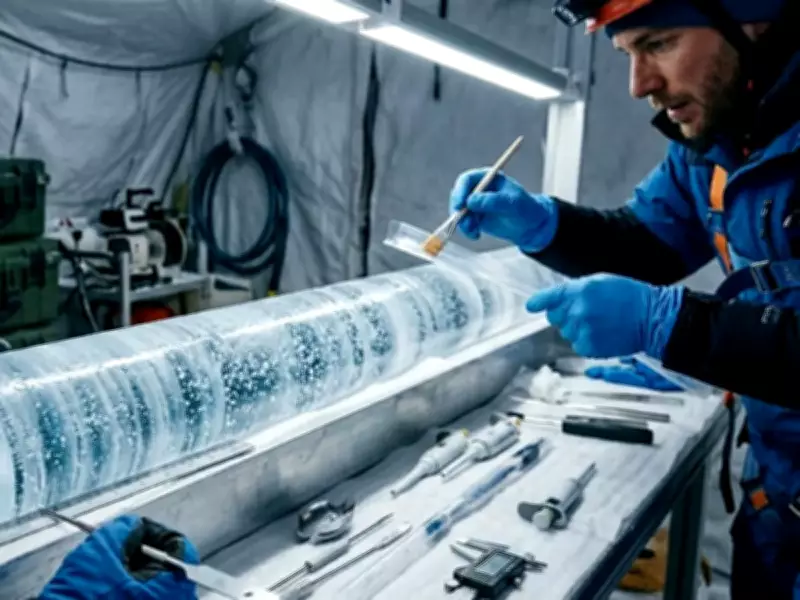
Deep under East Antarctica, scientists are drilling into one of the oldest frozen records on Earth. The Beyond EPICA project aims to retrieve continuous Antarctic ice cores dating back as early as 1.5 million years. This mission is based on the assumption that the ice may carry traces of changes in the composition of Earth's atmosphere even before humans walked the planet.
Why Scientists Are Chasing Ancient Antarctic Ice
The reason scientists are after ancient ice is simple: it is rich with information beyond its frozen state. For instance, the air bubbles contained in each layer hold samples of ancient air, including gases such as CO2 and methane. These gases enable the direct study of past atmospheres without relying solely on indirect evidence. According to the British Antarctic Survey (BAS), this is one of the few ways we can directly sample ancient atmospheres. The ice core serves not just as a geological sample but also as an archive of Earth's climate systems through time.
The Significance of the Age Objective
Current ice cores can already trace back the climatic record to about 800,000 years ago. The Beyond EPICA project seeks to break this boundary by retrieving ice dating back 1.5 million years. This would provide unprecedented insights into Earth's climate history.

Legacy of the EPICA Record
The current drilling project follows a previous initiative called the EPICA Dome C ice core project. A groundbreaking paper in Nature in 2004 documented the ice record, then estimated to be about 740,000 years old, later revised to around 800,000 years old. This previous core revolutionized climatology by establishing the correlation between greenhouse gases and ice age cycles. Going beyond EPICA aims to probe even further back in time.
Scientists are particularly interested in the Mid-Pleistocene Transition, an era when ice age cycles underwent significant changes. There is no consensus among experts about what caused this shift, and the ancient ice could provide the explanation. The Antarctic ice core holds a 1.2 million-year climate archive.
Selecting Sites for Drilling
Unlike many scientific endeavors, drilling ice cores is not left to chance. Researchers rely on techniques like radar imagery, geological maps, and models of ice flow to predict areas with potential to hold very ancient layers. As explained by BAS, the main reason for choosing Little Dome C was the assumption that the ice would be old, undisturbed by melting, and stable.
Scientists managed to obtain data spanning more than 1.2 million years from this location. Consistent layering enables scientists to compare levels of greenhouse gases, snow, and climatic shifts on a timescale measured in hundreds of thousands of years.
Why Do Bubbles Matter So Much?
Perhaps the most astonishing characteristic of the ice core is its unseen one: air bubbles trapped in the ice represent actual samples of the ancient atmosphere. Scientists can precisely measure the concentrations of CO2 and methane found in these bubbles. This data will give them insights into how climatic systems responded to natural changes over hundreds of thousands of years.
According to the CORDIS research project database for the European Union, the Beyond EPICA mission aims to retrieve the oldest ice with such atmospheric history. At the very bottom of this core, there might be air older than all human civilization combined.
A Frozen Archive Containing Many Secrets
The Beyond EPICA project is an active one, and experts emphasize that further research is required. Specialists do not know how old each layer is, nor whether the ultimate record will be full enough. Nevertheless, the project already has the potential to be considered one of the most significant studies of Antarctic climates in recent years. The Beyond EPICA project transforms a distant part of East Antarctica into an archive of Earth's atmosphere. The reason the discovery is so valuable lies in its simplicity: air samples from a million years ago have been stored in ice until researchers decide to extract them from their long-lasting storage.