Archaeologists occasionally stumble upon amazing findings in the quirkiest spots. So when a rare Iron Age shield turned up near Enderby, Leicestershire, it blew researchers away. Buried under soggy earth for over 2,300 years, this unique artefact has shaken up long-held ideas about ancient battles, craftsmanship, and defence.
Unlike other Iron Age shields, usually made of wood with some metal reinforcement, this one is mostly tree bark. It is the first of its kind found in Europe, according to experts. Preserving a peek at prehistoric Britain, it highlights a splash of innovation and tech know-how historians missed before. What is super cool is that this discovery hints at ancient groups using complex organic tech, which has mostly vanished from our digs today.
The Extraordinary Enderby Shield That Astonished Archaeologists
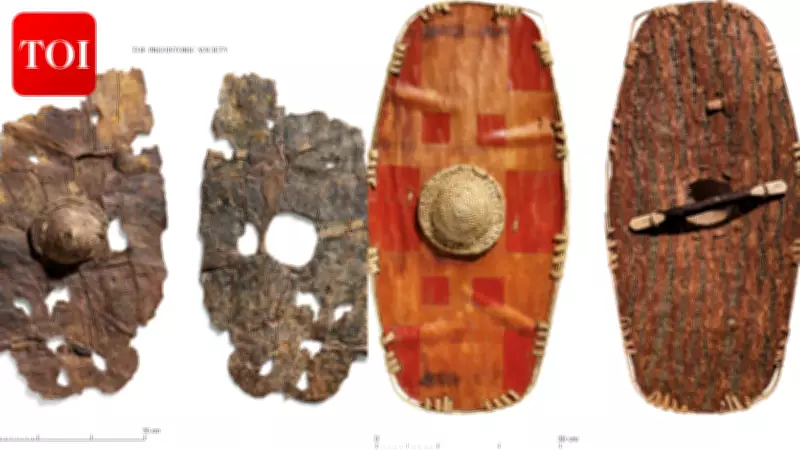
University of Leicester Archaeological Services (ULAS) discovered the shield at Everards Meadows near Enderby in 2015. It dates back from 395 BC to 255 BC, so we know it is from the Middle Iron Age. Measuring around 67 cm by 37 cm, this unique shield was crafted from willow bark, with wooden strips for reinforcement, a woven boss for protection, and a sturdier rim. Even though the shield looks delicate, experts say it was meant for use rather than show.

As stated by the University of Leicester research team, "This 2,300-year-old bark shield is the only one like it in all of Europe."
It was found in what seems to have been a livestock watering hole. Thanks to the waterlogged environment, the organic materials survived for over two thousand years. So, it is the conditions there that allowed us to find this amazing, ancient artefact today.
Ancient Weapon Technology Challenges Everything Experts Thought They Knew
At first, researchers were not sure if a bark shield could hold up in battle. But after doing a bunch of hands-on experiments, they were surprised by what they found. Turns out, shields made from bark were actually pretty protective and a lot lighter than wood or metal ones. The bark's natural characteristics make for a sturdy yet flexible defensive shield.
Dr Rachel Crellin from the University of Leicester chimed in: "I was not convinced the shield would work well at first, but our tests proved it would be effective on the battlefield."
Also, experts checked out the original artefact and spotted possible signs of battle wear and tear, like a hole likely from an iron spear and marks probably left by blades. According to a Cambridge study titled ‘The Enderby Bark Shield: A New Model for the Ancient World’ published in 2024, the design of the Enderby shield shows a lot of skill. It was not just some random creation; the researchers think it is a version of a design that had already been around for a while, maybe even tested with metal ones. So it was likely a reliable choice for protection in combat.
Why This Rare Find Is Transforming Our Understanding of Iron Age Britain
The Enderby shield is not just special because it is rare; it possibly shows a whole bunch of old tech we barely see anymore. You know why we do not see much? Organic stuff like bark and fibres usually just rots away before anyone can find it. That means our past societies probably used way more of this stuff than what we know from the remains we have found.
Adams, Beamish, and their team put it nicely in their study: "This shield is typical of protections used in the 1st millennium BC compared to its later metal versions." The discovery shows how skilled Iron Age people were. The shield features smart wooden supports, a woven middle, and neat red designs! So, it was clearly both functional and pretty.
Now, the British Museum safeguards this artefact, which offers insights into daily life, battles, and craft-making in those times.