Science is a world of wonder where magic can be calculated and created precisely. From objects to humans, science has found a way to create it all from scratch. But the dream of invention can make some go mad with desire enough to experiment on themselves, willing to bet their life on it. Here are eccentric scientists who took themselves as a subject to realise their dreams.
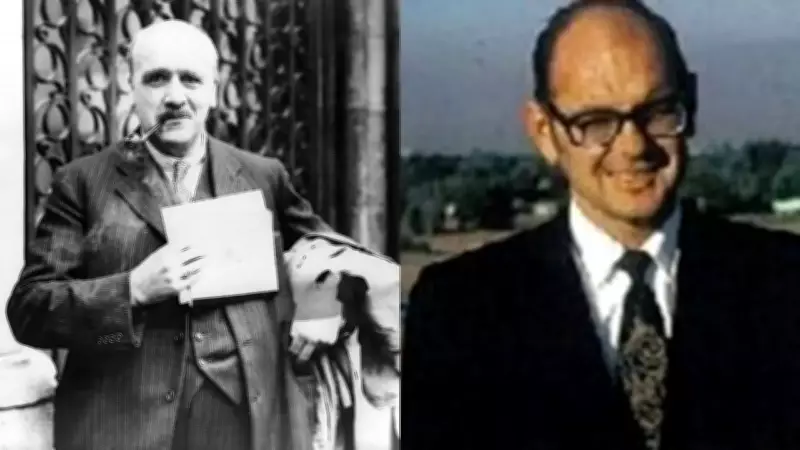
J.B.S Haldane
This British-Indian physician of the early 20th century conducted numerous experiments across many fields. However, one of the areas that he was most interested in was the effects of deep-sea diving on the sailors. He would often place himself in a decompression chamber, which was essentially a steel tube of 4ft diameter to simulate the effects and jot down the records himself. Once numerous bouts of decompression gave him an oxygen-induced seizure and crushed several of his vertebrae in the process. In another instance, he ruptured his eardrum by increasing the pressure of the decompressor.
Barry Marshall
In 1984, Australian microbiologist Barry Marshall finally figured out what causes different types of stomach ulcers. He thought a bacterium called Helicobacter Pylori was the cause but he had to prove it. When the hospital ethics committee refused to let him test this hypothesis on anyone, he secretly injected a broth containing the bacteria into himself. He soon contracted gastritis and published his work. Marshall was awarded the Nobel Prize in Physiology or Medicine in 2005 for discovering that bacteria and not stress, cause stomach ulcers.

Regine Greis
Sleep tight and don't let the bed bugs bite. Regine Greis and her husband Gerhard, both biologists at Simon Fraser University, were working to synthesise a pheromone that would keep the critters away from human furniture. However, in the research process, Greis has subjected herself to about 200,000 bed bug bites. She fills five jars with these insects and places them upside down on her forearm and lets them feast on her blood. But not for nothing, Greis discovered that bed bugs release a pheromone made up of some components that attract the insects and keep them put. We can now recreate the chemical makeup of the pheromone and attract these bugs to end their lives.
Henry Smolinski
Bored with his engineering job, Henry Smolinski finally quit it to pursue his dream of creating the world's first commercially viable flying car. He decided to merge a Ford Pinto with the wings and tail of a Cessna Skymaster, a small twin-engine aircraft. After several test flights, the production of a commercial set-up was mere months away when Smolinski along with his co-founder Harold Blake took the hybrid vehicle for a test drive. Their dream crashed down fast on Earth due to the wings failing, which led to their deaths.
Colonel John Stapp
The motto of the US Air Force is service before self and Colonel John Stapp took it very seriously. He became famous while studying the effects of deceleration on his body. In 1945, with the help of Wright Air Development Centre, he created a rocket sledge called the 'Gee Whiz'. Over the next 10 years, he subjected himself to massive G-forces as high as 632 miles per hour, earning the title of 'fastest man on Earth.' He carried out 29 rides in five seconds with a stop in one second on this sledge and found out that humans can defend such sudden stops if they put a seat belt on. Over the years, he fractured wrists, broke his ribs and even had his retina removed, all to continue the experimentation.